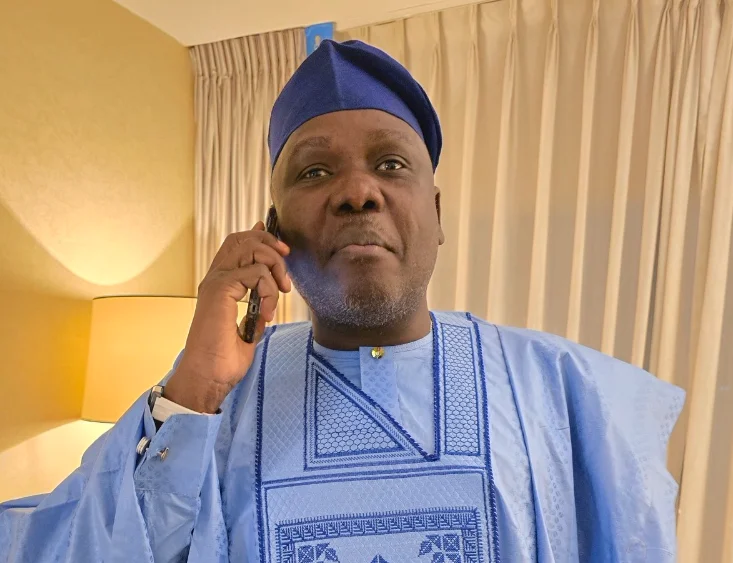
Presidential aide Daniel Bwala has alleged that a leadership dispute between the Nigerian Army and the Nigerian Air Force during the administration of former President Muhammadu Buhari disrupted military operations by denying ground troops critical air support during counterinsurgency missions.
Bwala made the remarks during The Link Up Podcast, a panel discussion hosted by EchoRoom and published on Friday. He claimed that disagreements between the then Chief of Army Staff and the Chief of Air Staff affected cooperation between the two services, resulting in delayed or absent air cover for troops engaged in military operations.
According to him, requests for aerial support were at times not honored because of the strained relationship between the military leadership, a situation he said undermined operational effectiveness.
“I remember during Buhari there was this disagreement that was imported to be between the Chief of Air Staff and that of the Army, so that whenever an operation was undertaken, when they asked for air cover, there wouldn’t be support. In this administration, it is not so. There is coordination or cooperation,” Bwala said.
Responding to questions about allegations that terrorists may have infiltrated Nigeria’s security forces, Bwala dismissed claims that soldiers deliberately protect terrorist groups, describing such assertions as speculative unless backed by concrete evidence.
He, however, acknowledged that no security institution is completely immune from infiltration, noting that isolated cases involving compromised personnel have occurred in Nigeria and other countries.
“You cannot rule out the facts that they may have one or two agents in the army, anywhere else,” he said, pointing to previous instances in which police officers and soldiers were arrested for alleged involvement in criminal activities.
Drawing international comparisons, Bwala cited the case of former U.S. intelligence contractor Edward Snowden as an example of how security breaches can occur even within advanced intelligence systems.
He added that the government has measures in place to address internal security threats but declined to disclose details, saying such information could undermine ongoing efforts.
The presidential aide also suggested that Nigeria’s security challenges have an international dimension, referring to previous demonstrations in parts of northern Nigeria where protesters displayed Russian flags following certain foreign policy decisions by the Federal Government.
Bwala further referenced comments made by U.S. Congressman Scott Perry, who previously alleged during a congressional hearing that the Central Intelligence Agency (CIA) had funded terrorist groups, including Boko Haram and the Islamic State (ISIS). Bwala stressed that he was not validating the allegation but noted that such discussions had taken place publicly.
“I’m not saying he’s right or wrong. But what I’m saying is that an event like that has occurred, and as a country we cannot simply ignore such conversations,” he said.
Beyond security issues, Bwala praised the administration of President Bola Ahmed Tinubu, saying the government had made notable progress in strengthening Nigeria’s economy through improvements in foreign reserves and government revenue.
He expressed confidence in the administration’s performance, stating that President Tinubu had done enough to earn the confidence of Nigerians, while emphasizing that the decision on whether the President deserves a second term ultimately rests with the electorate.