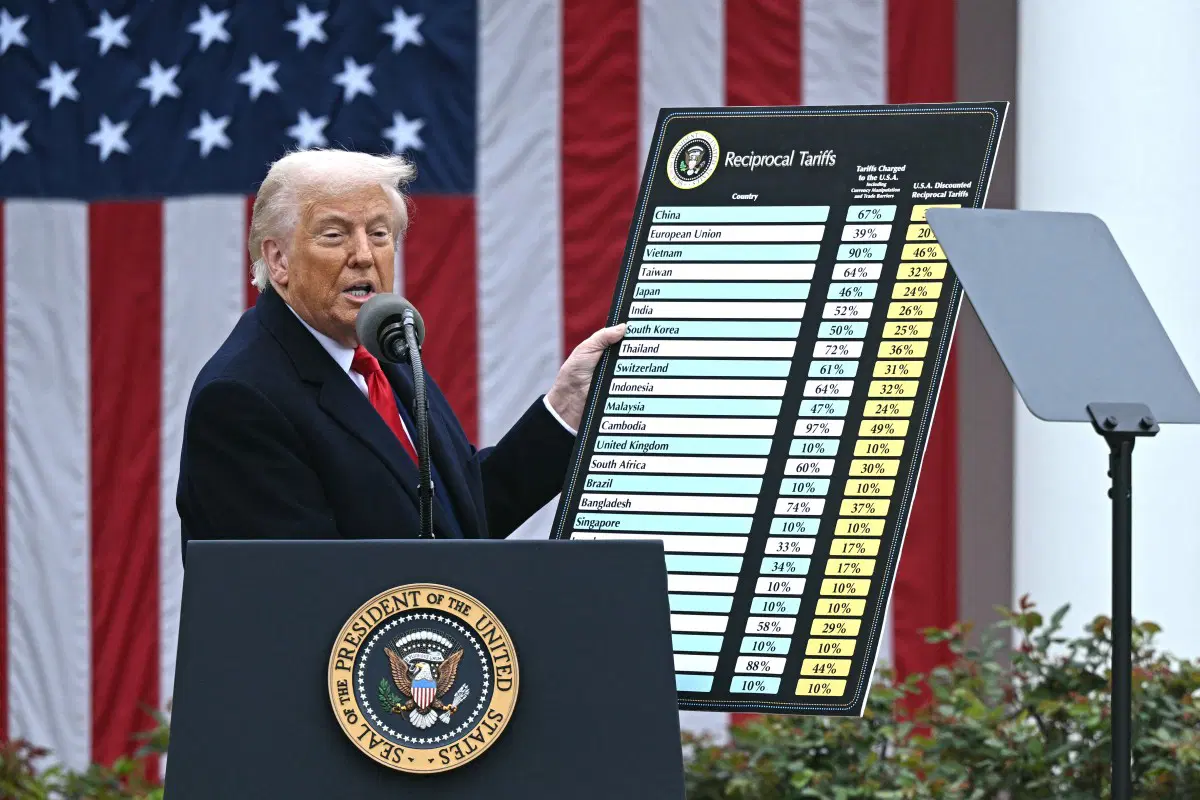
Former U.S. President Donald Trump scored a temporary legal victory on Thursday after a federal appeals court granted a stay allowing his sweeping tariffs on Chinese and other foreign imports to remain in place — at least for now. This move comes just one day after the U.S. Court of International Trade (CIT) ruled that Trump had exceeded his presidential powers by imposing broad levies on imports under emergency declarations.
The ruling from the U.S. Court of Appeals for the Federal Circuit temporarily halts the enforcement of the CIT’s decision, offering short-term relief to Trump’s controversial trade strategy while a broader legal battle plays out.
Reacting to the development, Trump criticized the Manhattan-based trade court, branding it “horrible” and urging for its decision to be overturned “quickly and decisively.” The former president has long used tariffs as a core tool to reshape U.S. trade relationships, often targeting allies and rivals alike under the banner of national economic security.
Legal Showdown and Trade Negotiations
The appeals court’s administrative stay gives the White House room to continue imposing the contested tariffs, which have impacted goods from countries including China, Canada, and Mexico. The CIT’s earlier ruling had found several of Trump’s duties unlawful, including blanket 10% tariffs and emergency levies applied to dozens of trading partners.
Despite this legal uncertainty, Treasury Secretary Scott Bessent said trade talks with China remain “a bit stalled,” but suggested that only direct intervention from Trump and Chinese President Xi Jinping could lead to a breakthrough.
“Given the magnitude and complexity of the negotiations, this will require both leaders to weigh in personally,” Bessent said during an interview with Fox News.
Beijing responded cautiously to the evolving U.S. legal situation. Chinese officials called for Washington to scrap the “wrongful unilateral tariff measures,” warning that continued pressure could derail ongoing talks. China’s commerce ministry spokeswoman, He Yongqian, urged the U.S. to consider both international opinion and domestic business concerns.
White House Stands Firm
Trump administration officials have defended the tariff policy, emphasizing the president’s authority under the International Emergency Economic Powers Act (IEEPA) of 1977. White House spokeswoman Karoline Leavitt criticized the lower court’s decision, accusing the judges of “brazenly abusing their judicial power.”
She added that the administration was confident of winning on appeal and that the president still had legal avenues to impose tariffs even if the court ultimately ruled against the current measures.
“The Supreme Court must put an end to this judicial overreach,” Leavitt stated.
In Washington, a separate federal judge also ruled that some of Trump’s tariffs violated statutory limits and gave the administration two weeks to file an appeal — adding another layer of complexity to the dispute.
Economic and Political Impact
The legal tug-of-war comes at a time when the U.S. is renegotiating multiple trade agreements. National Economic Council Director Kevin Hassett called the CIT ruling a “hiccup” and insisted that ongoing negotiations with several countries remained unaffected.
Peter Navarro, Trump’s trade advisor, claimed that nations were still “negotiating in good faith,” though he did not name specific countries.
Trump’s tariff strategy, designed to reduce trade deficits and counter drug smuggling, has been deeply polarizing. While some view it as a necessary economic defense, critics argue it has disrupted global supply chains and strained diplomatic ties.
The CIT ruling stems from two lawsuits brought by business coalitions and state governments. They argued that the IEEPA does not grant the president unlimited authority to impose tariffs. The court agreed, stating that interpreting the IEEPA to allow sweeping trade actions would be unconstitutional.
What’s Next?
Legal analysts believe the case is likely headed to the U.S. Supreme Court. However, the appeals court’s stay means that the status quo — with most of Trump’s tariffs intact — will hold during the appeals process.
Meanwhile, global markets, businesses, and foreign governments continue to navigate the uncertainty surrounding U.S. trade policy — a hallmark of Trump’s presidency that shows no signs of fading.