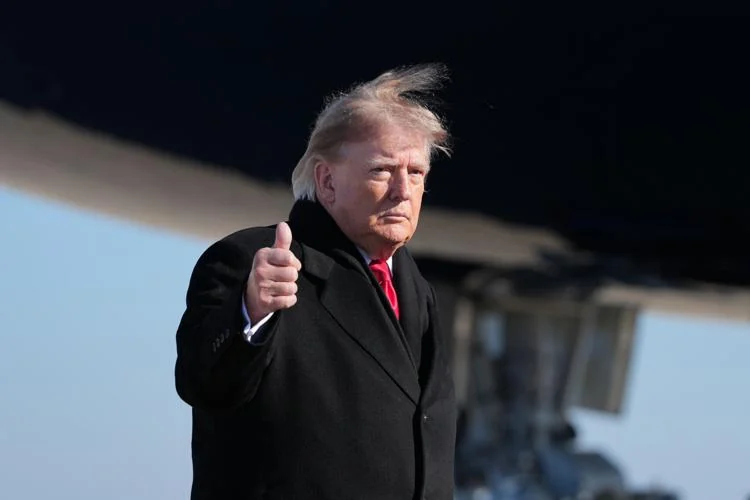
US President Donald Trump has arrived in Manila, the Philippines, ahead of a high-level meeting of the Quad alliance involving the United States, Japan, Australia and India, as Washington prepares for crucial diplomatic engagements with China.
Trump arrived in the Philippine capital on Tuesday at the conclusion of the Association of Southeast Asian Nations (ASEAN) summit, where demonstrations against his policies were held across the city.
His Asian tour will also include the Asia-Pacific Economic Cooperation (APEC) summit in Shenzhen, China, and an anticipated trilateral meeting involving Chinese President Xi Jinping and Russian President Vladimir Putin.
The visit comes amid growing tensions between Washington and Beijing over trade restrictions, allegations of espionage and US measures limiting China’s access to advanced artificial intelligence chips.
The developments could further complicate the fragile trade truce between the two economic powers.
In Manila, protesters staged demonstrations for the fifth consecutive day, burning effigies of Trump and demanding an end to the war in the Middle East. They also called for the scrapping of the US-led Pax Silica supply chain initiative.
Trump is expected to participate in a US-ASEAN Special Summit later on Tuesday, following the Quad meeting. The gathering will mark his first participation in the four-country alliance’s summit since returning to the White House.
The meeting comes two years after the last Quad summit, an initiative strongly promoted by former US President Joe Biden as part of Washington’s regional foreign policy strategy.
The alliance, comprising the United States, Japan, Australia and India, focuses on strengthening security and economic cooperation across the Indo-Pacific region.
Although China has repeatedly criticised the grouping, viewing it as an attempt to contain its growing influence, member countries maintain that the alliance is not directed against any particular nation.
The Quad discussions are expected to cover maritime security, export restrictions, critical minerals supply chains and artificial intelligence.
Undersea cables, emerging technologies and disaster relief are also expected to feature prominently.
Former US Deputy Secretary of State Kurt Campbell credited Secretary of State Marco Rubio with pushing for the revival of the Quad meeting, arguing that the alliance had lost some of its momentum under Trump’s leadership.
Campbell said the gathering would send an important diplomatic signal ahead of Trump’s anticipated discussions with China and Russia.
Meanwhile, Chinese Premier Li Qiang used Monday’s ASEAN summit to highlight China’s economic achievements and strengthen Beijing’s relationship with Southeast Asian countries.
Li reaffirmed China’s commitment to free trade, urging countries to work together against external interference and global economic uncertainty.
China remains ASEAN’s largest trading partner and a major source of investment. However, leading economies within the 11-member bloc are also seeking stronger economic ties with the United States despite continuing trade and diplomatic uncertainties.
Japanese Prime Minister Sanae Takaichi also pledged closer cooperation with ASEAN, particularly in strengthening economic and energy security, improving critical mineral supply chains and addressing challenges arising from artificial intelligence.
Trump is additionally expected to sign a joint statement with Thai Prime Minister Anutin Charnvirakul on Tuesday concerning a reciprocal trade agreement.
The discussions are expected to address progress in trade negotiations between Washington and Bangkok. The United States remains Thailand’s largest export market, accounting for 24 per cent of the country’s total exports this year.
Trump is scheduled to meet Philippine President Ferdinand Marcos Jr. on Wednesday before travelling to Shenzhen, China, for the APEC summit, where attention will focus on his anticipated high-level discussions with Chinese leadership.