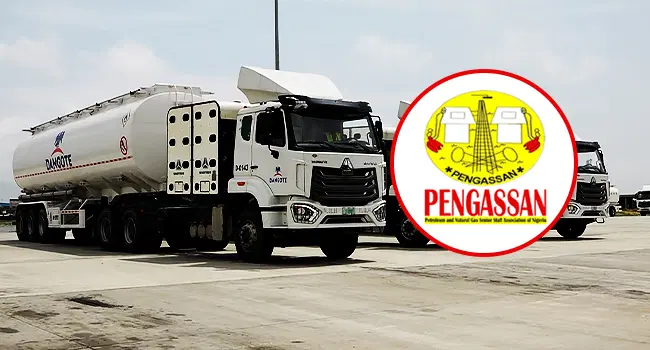
A nationwide strike launched by the Petroleum and Natural Gas Senior Staff Association of Nigeria (PENGASSAN) against Dangote Refinery has intensified, as the union vowed to press on with its industrial action despite a restraining order issued by the National Industrial Court.
The standoff deepened on Monday when PENGASSAN’s General Secretary, Lumumba Okugbawa, issued a strongly worded memo dismissing reports that the court had halted the strike. The memo, circulated to union members across the country, insisted that the association had not been served with any formal court order and therefore had no legal obligation to suspend its protest.
“Our attention has been drawn to rumours making rounds on a court injunction restraining our noble exercise,” Okugbawa wrote. “I want to unequivocally state that we have not been served anything of such. Court orders or processes are served via court bailiff and not through social media.”
Reiterating the union’s stance, Okugbawa directed members nationwide to remain steadfast and continue the industrial action “until further instruction.” He warned members to disregard unofficial reports and rely solely on the association’s verified communication channels.
“All comrades are therefore directed to continue with the industrial action until further instruction. Only information coming through our official channels should be regarded as authentic,” the statement read.
He also commended union members for their determination and unity, saying, “We have just begun, and victory is in sight.”
The escalation comes despite a ruling earlier in the day by Justice Emmanuel Subilim of the National Industrial Court in Abuja, who granted a seven-day interim injunction restraining PENGASSAN from proceeding with the strike. The order followed an ex parte application filed by Dangote Refinery and argued by Senior Advocate of Nigeria, George Ibrahim.
In his submission, Ibrahim described Dangote Refinery as a critical facility vital to Nigeria’s economy and public welfare. He argued that the industrial action, if allowed to continue, could disrupt essential services and inflict irreparable harm on the refinery’s operations.
“The refinery employs over 3,000 Nigerians. Only a negligible number were affected by the reorganisation, which was purely on safety and operational grounds,” Ibrahim told the court. He also revealed that recent sabotage incidents by some employees had prompted a restructuring exercise affecting a few staff members.
Justice Subilim, in his ruling, agreed that the strike could severely undermine essential services and destabilise the refinery’s operations. He consequently issued a seven-day interim order restraining PENGASSAN from continuing the strike, pending the hearing of the motion on notice scheduled for October 13. The court also directed that the order be immediately served on all parties involved.
Despite the court’s directive, PENGASSAN’s defiance signals a potentially protracted confrontation between the powerful oil and gas workers’ union and Africa’s largest refinery, raising concerns about possible disruptions to the nation’s energy sector if the impasse is not resolved swiftly.