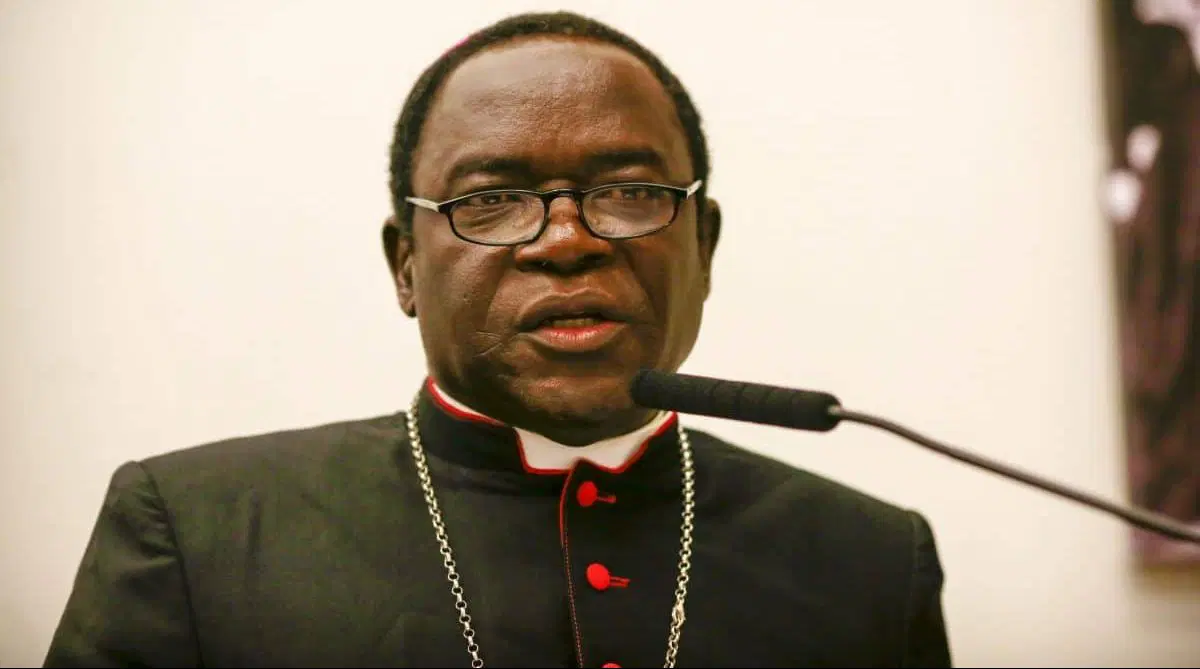
Catholic Bishop of Sokoto Diocese, Most Rev. Matthew Kukah, has come under public criticism following what activists have described as a “surprising reversal” of his previous stance on the alleged persecution of Christians in Nigeria.
The backlash stems from remarks made by Bishop Kukah during the launch of the Aid to the Church in Need (ACN) 2025 World Report on Religious Freedom at the Augustinianum Hall in Vatican City on October 21, 2025. Speaking at the event, Kukah reportedly urged the international community not to impose diplomatic isolation or sanctions on Nigeria, despite acknowledging the country’s ongoing governance and security challenges.
His comments have drawn strong reactions from rights advocates, including Dr. Thompson Udenwa, who accused the cleric of inconsistency and of backtracking on his earlier appeals for stronger international action against religious intolerance in Nigeria.
In a statement issued in Abuja on Wednesday, Udenwa reminded the public that Bishop Kukah had been one of the most prominent voices calling for the United States to designate Nigeria as a Country of Particular Concern (CPC) for religious freedom violations during the Buhari administration.
“It is confusing that the same bishop who, in 2021, addressed the U.S. Congress and condemned the Buhari government’s failure to protect Christian communities is now opposing the very measures he once described as moral justice,” Udenwa said. “Such a reversal weakens the credibility of faith-based advocacy and suggests that Bishop Kukah’s recent position may be politically influenced rather than principled.”
Udenwa argued that Kukah’s new approach, which emphasizes dialogue over punitive measures, risks emboldening Nigerian authorities to continue ignoring attacks on churches and Christian communities, particularly in the North and Middle Belt regions.
“While dialogue is important, religious leaders must be consistent and selfless in their advocacy,” he added. “Truth should be upheld regardless of who holds power.”
Bishop Kukah has long been a vocal critic of poor governance and insecurity in Nigeria, often urging accountability and inclusive leadership. However, his latest remarks appear to have reopened debate over the balance between diplomacy and justice in addressing faith-based violence in the country.