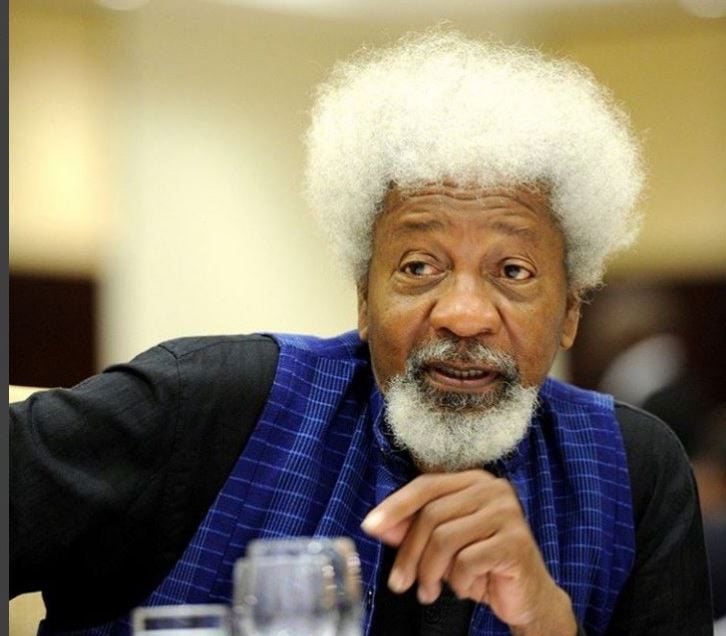
Nobel laureate Professor Wole Soyinka has shed light on why he refused to honour an invitation by the United States Embassy for a visa re-interview in September, citing discomfort with the symbolic date — September 11 — chosen for the appointment.
Soyinka, who described himself as “superstitious,” said he found it unsettling that the embassy would select September 11 — the anniversary of the 2001 terror attacks on the World Trade Center — for his re-interview.
The literary icon spoke during a media parley titled “Unending Saga: Idi Amin in Whiteface” held at Kongi’s Harvest Gallery, Freedom Park, Lagos Island, where he revealed that his U.S. visa had been revoked.
“I declined the invitation. First of all, I didn’t like the date. Everybody knows what happened on that date, 9/11, many years ago. It is rather unfortunate that they picked that date,” Soyinka said. “I said, ‘Sorry, I’m superstitious; I’m not coming on that day.’ And ultimately, I made it clear I was not going to apply for another date to bring in my passport.”
Soyinka, 91, disclosed that he received a formal notification of his visa revocation in a letter dated October 23, 2025, from the U.S. Consulate in Lagos. The letter cited U.S. Department of State regulations (22 CFR 41.122) and instructed him to return the visa for physical cancellation.
Mocking the demand, Soyinka told journalists, “The embassy wants me to bring my visa for physical cancellation. Maybe one of you would like to volunteer to deliver it for me.”
The Death and the King’s Horseman playwright, who has long been a vocal critic of U.S. President Donald Trump, said he called the press briefing to inform those expecting him in the U.S. that he was effectively “banned.”
“It is necessary for me to hold this press conference so that people in the United States who are expecting me for this event or that event do not waste their time. I have no visa; I am banned, obviously, from the United States,” Soyinka said. “If you want to see me, you know where to find me.”
Despite the revocation, Soyinka emphasized that the decision would not affect his relationship with Americans. “I have absolutely nothing against individual citizens of the United States. There are remarkable beings in that place — friends, colleagues, philosophers, artists,” he stated.
The renowned author, who became Africa’s first Nobel Laureate in Literature in 1986, said he saw no reason to reapply for a new visa. “How old am I now? What am I looking for anywhere? I’ve given as much as I’ve taken from that place. They owe me nothing, and I owe them nothing,” he remarked.
Soyinka added that he had informed the U.S. Ambassador in Lagos that he and his staff were always welcome to visit the “Autonomous Republic of Ijegba” — his artistic enclave in Abeokuta, Ogun State.
The incident has stirred debate about recent changes in U.S. visa policies toward Nigeria. Earlier this year, the U.S. Department of State announced that most non-diplomatic visas issued to Nigerian citizens would now be single-entry with a three-month validity period. The embassy also began requiring applicants to disclose all social media handles used in the past five years as part of enhanced security screening.
For now, Soyinka insists he is unbothered by the diplomatic setback: “If circumstances change, yes, I will visit again — but I won’t take the initiative. There’s nothing I’m looking for there.”