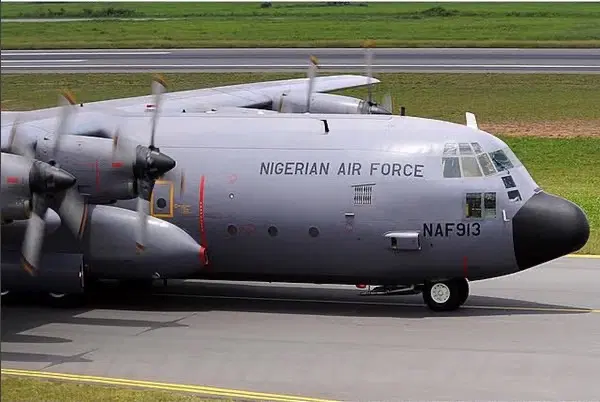
The Federal Government has confirmed that negotiations are still underway for the release of a Nigerian Air Force C-130 aircraft and 11 soldiers detained in Burkina Faso, noting that both the aircraft and personnel remain in custody.
The aircraft was seized on Monday after it made what the Nigerian Air Force described as a precautionary landing in Bobo Dioulasso while en route to Portugal for scheduled maintenance due to a technical fault.
Burkina Faso authorities, alongside officials of the Confederation of Sahel States (AES), however, alleged that the aircraft entered their airspace without proper clearance, insisting that this prompted the decision to compel the Hercules aircraft to land.
Speaking on the development, the spokesperson for the Ministry of Foreign Affairs, Mr Kimiebi Ebienfa, said the Federal Government was actively engaging the Burkinabe authorities through diplomatic channels to resolve the issue.
“We are engaging them, but they are yet to be released,” Ebienfa said, adding that the Ministry of Foreign Affairs had taken over the negotiations to ensure the safe release of the aircraft and the detained Nigerian military personnel.
Following the transfer of responsibility to the Ministry of Foreign Affairs, the Nigerian Air Force has declined further comments on the matter.
Although official details of the talks have not been made public, Vanguard contacted some retired Nigerian Air Force pilots to comment on the implications of detaining a military aircraft following an emergency landing. The officers cautioned against speculation, stressing that premature conclusions could undermine ongoing government-to-government discussions.
“In situations like this, where negotiations are still ongoing and facts are not fully clear, speculation could jeopardise diplomatic engagements and create avoidable risks. It is better to wait for the outcome,” one retired officer said on condition of anonymity.
Vanguard also gathered that Burkina Faso and other Sahel countries, including Mali and Niger—former members of the Economic Community of West African States (ECOWAS) that were suspended following military coups—may be seeking leverage through the incident.
According to a retired officer, the ECOWAS-imposed restrictions on trade and movement have significantly impacted the economies of the affected countries, a situation worsened by strained relations with France.
“They believe Nigeria has considerable influence within ECOWAS and may be using this incident as a bargaining tool to negotiate economic relief or support. However, how the situation eventually unfolds remains to be seen,” the officer said.