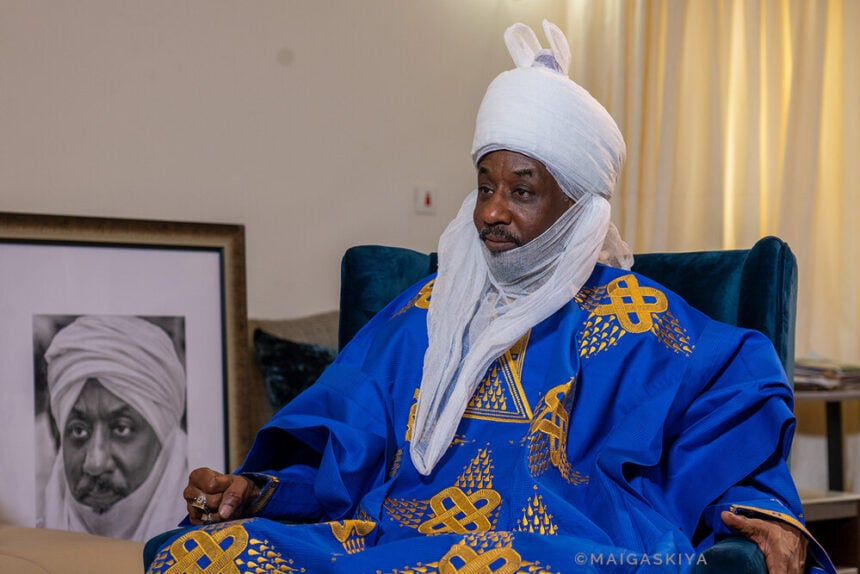
The Emir of Kano, Muhammadu Sanusi II, has reaffirmed the role of traditional rulers as critical stakeholders in Nigeria’s governance, saying he does not require constitutional provisions to offer counsel to political leaders.
Speaking on Channels Television’s Morning Brief on Wednesday, Sanusi stressed that his authority to advise the president or state governors comes from the people he represents, not from legal documents.
“Do I need to be told to advise the President? Do I need the Constitution to tell me that if I think there is something the country needs, I should go to the President and say, ‘Mr President, I think this is wrong?’” he asked.
He added that traditional leaders derive their legitimacy from their communities and therefore have both the right and responsibility to speak up on national issues.
“I don’t need the Constitution to tell the governor that I think this is what we should be doing. I get that authority from being a leader of the people,” Sanusi said, while acknowledging ongoing debates about formally recognising advisory roles for traditional institutions.
The Emir also underscored the importance of inclusive governance, calling for greater participation of women in political leadership. He said women play vital roles in nation-building and should be better represented in elective offices.
Addressing domestic violence, Sanusi condemned the abuse of women, describing it as a misuse of power rather than a cultural norm.
“Violence happens in all societies. It’s not about African culture. It’s about power relations where men have power and women are not protected,” he said, noting that vulnerable groups—including women, children, the poor, and persons with disabilities—often bear the brunt of such abuses.
He insisted that cultural beliefs must not be used to justify violations of fundamental human rights.
“You cannot beat a woman because your culture says you can. She’s a Nigerian citizen entitled to protection,” he stated.
Sanusi, widely known for his willingness to challenge authority, has consistently used his platform to speak on economic policy, social justice, and education, setting him apart from many traditional rulers who avoid public policy debates.
Under Nigeria’s constitution, traditional rulers hold no formal executive or legislative powers and are largely regarded as custodians of culture with ceremonial responsibilities.