President Bola Tinubu on Wednesday charged the newly decorated Acting Inspector-General of Police, Tunji Disu, to reform and reposition the Nigeria Police Force, declaring that the country faces a critical security moment amid rising banditry, terrorism and other violent crimes.
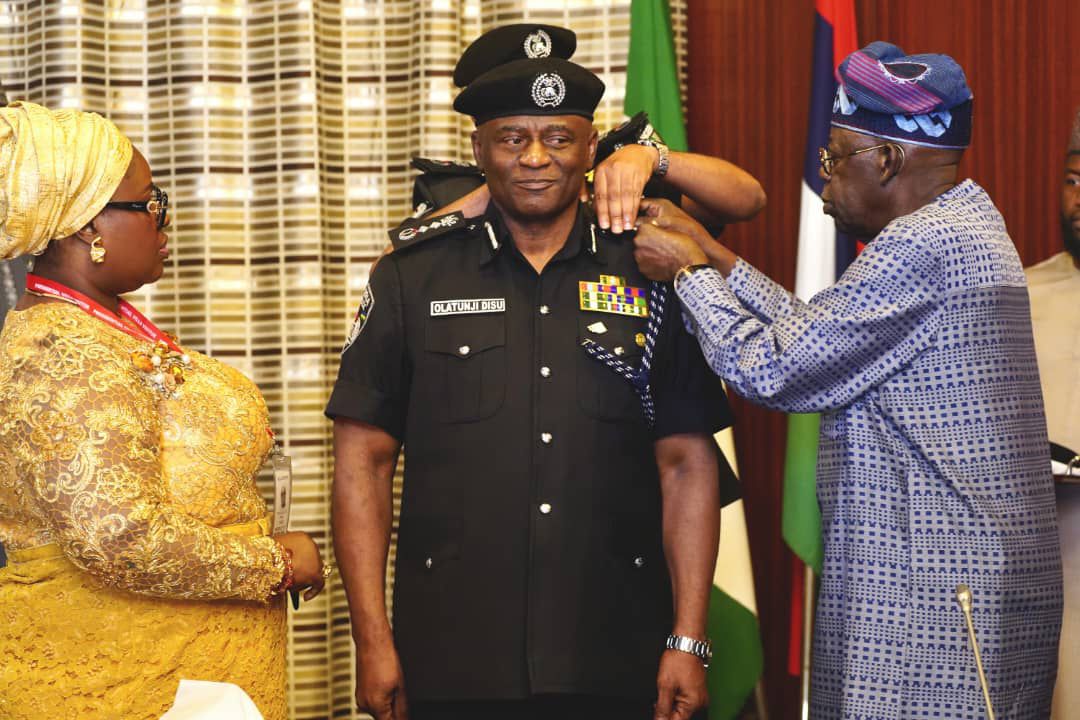
Tinubu personally decorated Disu with his new rank at the State House, Abuja, describing his appointment as coming at “a defining moment for our nation’s security.”
“The commitment that I expect from you is for you to make it better than you met it,” the President said during the ceremony. “Nigeria is challenged right now with banditry, terrorism and all sorts of criminal activities.”
‘Lead Firmly but Fairly’
Drawing from his time as Governor of Lagos State, Tinubu said he was familiar with Disu’s record and dedication to duty.
“I know your record. I believe in the dedication that you’ve exhibited while you were in Lagos,” the President said, urging the new police chief to strengthen discipline, promote professionalism and enhance inter-agency collaboration.
He tasked Disu to restore public confidence in the Force, lead firmly but fairly, and ensure the protection of lives and property remains the top priority.
“It is a daunting challenge. I know you can do it. You have my full support,” Tinubu added.
The President also encouraged the new IGP to draw from the experience of his predecessor, Kayode Egbetokun, who was present at the ceremony.
“To the outgoing Inspector-General of Police, I extend the gratitude of the entire country,” Tinubu said, adding that Egbetokun’s legacy would be tied to the success of his successor.
‘Era of Impunity Is Over’
In his response, Disu became emotional as he pledged to justify the confidence reposed in him, vowing to enforce discipline and stamp out corruption within the Force.
“I will let them know that the era of impunity is over,” Disu told State House correspondents. “I will ensure that I train them and encourage them to follow human rights. I will try to follow a regime of zero tolerance to corruption.”
He emphasised that Nigerian citizens are the ultimate bosses of the police.
“No police anywhere in the world can succeed without the cooperation of members of the public,” he said, promising to make community partnership central to policing efforts.
Egbetokun, in his remarks, expressed confidence in Disu’s capacity to surpass his achievements, noting that he had invested in grooming likely successors within the Force.
Transition and Tenure
The decoration came barely 24 hours after Egbetokun submitted his resignation letter, citing family reasons, although sources indicated he stepped down following discussions with the President.
Disu’s appointment comes just weeks before his scheduled retirement upon attaining the mandatory age of 60 on April 13, 2026. However, under the amended Police Act, an Inspector-General of Police is entitled to a fixed four-year tenure regardless of age, potentially keeping him in office until 2030, subject to confirmation.
According to presidential spokesman Bayo Onanuga, Tinubu will soon convene the Nigeria Police Council to formally consider Disu’s appointment as substantive IGP before forwarding his name to the Senate for confirmation.
Assumes Duty at Force Headquarters
Shortly after the decoration, Disu formally assumed duty at the Force Headquarters, where he took his first salute from members of the Quarter Guard before proceeding to a handover ceremony with Egbetokun.
In his inaugural address to senior officers, Disu acknowledged deep-rooted challenges within the Force, including a trust deficit with communities, outdated systems, resource constraints and misconduct.
“These are truths we must confront with resolve in order to reposition the Nigeria Police as a trusted, people-oriented institution,” he said.
He outlined three priorities for his tenure: professionalism and modernisation; accountability and integrity; and strengthened community partnership.
On accountability, he declared that disciplinary measures would apply across all ranks without exception.
“The badge is a symbol of public trust. Anyone who treats it otherwise will face the full consequences of our disciplinary processes,” he said. “This applies at every rank, including those closest to me.”
Disu also pledged to embrace intelligence-led policing, forensic investigation, digital tools and evidence-based practices, while improving officers’ welfare and working conditions.
Born on April 13, 1966, Disu joined the Nigeria Police Force in 1992 and rose to prominence as Commander of the Rapid Response Squad in Lagos, later heading the Intelligence Response Team. Before his elevation, he served as Assistant Inspector-General of Police in charge of the Force Criminal Investigation Department Annex in Lagos.
With his appointment, at least nine Deputy Inspectors-General are expected to retire in line with established police tradition when a junior officer assumes the top position.
As he takes charge of Africa’s largest police force, Disu now faces the formidable task of rebuilding trust, enforcing discipline and confronting Nigeria’s escalating security challenges.