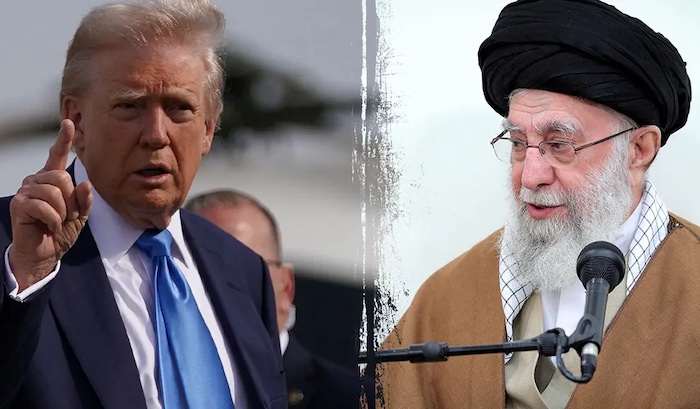
United States President, Donald Trump, on Saturday confirmed that Iran’s Supreme Leader, Ayatollah Ali Khamenei, and 40 top Iranian military and civilian leaders were killed during coordinated airstrikes carried out by the United States and Israel against Iran.
The strikes, launched earlier in the day, targeted key military and intelligence installations across Iran. Trump described the operation as a decisive blow against the Iranian leadership, declaring in a post on Truth Social that Khamenei was “dead” and calling it “justice for the people of Iran” and others he accused the Iranian leader of harming.
In his remarks, Trump said members of Iran’s Islamic Revolutionary Guard Corps were reportedly seeking immunity from the United States. He added that some elements within Iran’s security and military apparatus were no longer willing to fight and were considering aligning with what he described as Iranian patriots.
The Islamic Revolutionary Guard Corps, officially known as the Islamic Revolutionary Guard Corps, plays a central role in Iran’s military and political structure.
Trump urged Iranians to “seize control of your destiny” and rise against the Islamic leadership that has governed the country since 1979. He further stated that the bombing campaign would continue “throughout the week or as long as necessary” to achieve what he called peace in the Middle East.
Regional Retaliation and Airspace Closures
In response, Iran reportedly launched retaliatory strikes against several countries hosting US military bases or considered American allies, including Saudi Arabia, Jordan, Qatar, the United Arab Emirates, Kuwait, Bahrain, and Syria.
The United States is believed to maintain approximately 13 military bases across the Middle East, with an estimated 30,000 to 40,000 troops typically deployed in the region.
According to Reuters, the escalating hostilities forced widespread airspace closures across the region. At least eight countries — including Iran, Israel, Iraq, Jordan, Qatar, Bahrain, Kuwait and the United Arab Emirates — shut their airspace. Syria also announced a partial closure of its southern airspace along its border with Israel for 12 hours.
Israeli Leaders Weigh In
Israeli Prime Minister, Benjamin Netanyahu, said the initial wave of strikes had decimated Iran’s chain of command, killing seven senior defence and intelligence officials and targeting about 30 top leaders overall.
Netanyahu claimed there were strong indications that Khamenei had been killed when his compound in Tehran was struck.
“This morning, in a powerful surprise strike, the compound of the tyrant Ali Khamenei was destroyed in the heart of Tehran,” Netanyahu said in a televised statement, adding that there were “many signs” the Iranian leader was no longer alive. He also called on Iranians to take to the streets to topple the regime.
Among those reported killed were senior Iranian officials, including Ali Shamkhani, Mohammad Pakpour, Aziz Nasirzadeh, Mohammad Shirazi and Saleh Asadi. The chairman of Iran’s nuclear weapons research organisation, SPND, Hossein Jabal Amelian, and former chairman Reza Mozaffari-Nia were also said to have been eliminated.
However, reports indicated that Ali Larijani, Secretary of Iran’s Supreme National Security Council and a close confidant of Khamenei, survived the attacks.
International Fallout and Oil Concerns
Tehran reportedly called for an emergency meeting of the United Nations nuclear watchdog following the strikes, while European Union foreign ministers were scheduled to hold extraordinary talks.
Analysts predict oil prices could surge sharply when markets reopen, as Iran has repeatedly threatened to block the Strait of Hormuz — a critical maritime corridor linking Middle Eastern oil producers to global markets.
More than 250 people were reportedly killed across Iran during the bombardment. An Iranian official said at least 85 victims died when a strike hit a girls’ school, underscoring the mounting humanitarian toll as tensions escalate across the region.