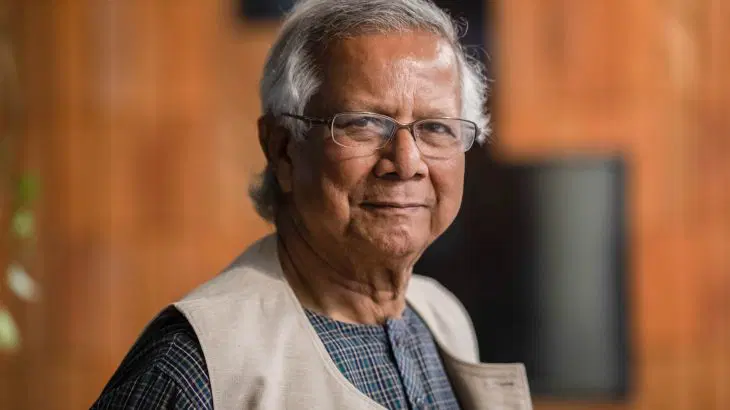
Dhaka, Bangladesh – Nobel Peace Prize laureate and microfinance pioneer Muhammad Yunus has been appointed to lead an interim government in Bangladesh following mass protests that forced long-serving Prime Minister Sheikh Hasina to flee the country. The presidency announced the decision on Wednesday.
The announcement came swiftly after student leaders urged the 84-year-old Yunus, renowned for his work in lifting millions out of poverty, to assume leadership. President Mohammed Shahabuddin convened a meeting with the heads of the army, navy, and air force, along with student leaders, to finalize the decision.
In a statement, Shahabuddin’s office declared, “(They) decided to form an interim government with Professor Dr. Muhammad Yunus as its chief.” The president called for public support to navigate the crisis, emphasizing the necessity of quickly establishing the interim government.
Yunus, who will hold the title of Chief Advisor, was endorsed by Haid Islam, one of the leaders of Students Against Discrimination who attended the meeting. Islam described the meeting as “fruitful” and confirmed that the interim government would be formed as soon as possible.
Currently in Europe, Yunus expressed his willingness to lead the interim government in an interview with AFP on Tuesday. “If action is needed in Bangladesh, for my country and for the courage of my people, then I will take it,” he stated. Yunus also wrote in The Economist, advocating for a free and fair election within a few months and calling for a new generation of leaders to step forward.
The political upheaval reached a climax on Monday when Prime Minister Sheikh Hasina, who had been in power since 2009, resigned amid massive protests in Dhaka. The demonstrations, initially sparked by a plan to impose quotas in government jobs, evolved into a broader anti-Hasina movement. Accused of election rigging and human rights abuses, Hasina deployed security forces to suppress the protests, resulting in hundreds of deaths. Over the weekend, the military turned against her, leading to her escape to India.
General Waker-Uz-Zaman, the army chief, declared on Sunday that it was “time to stop the violence.” The military has since conceded to various demands from student leaders, including the appointment of Yunus. The president dissolved parliament on Tuesday, responding to another key demand from the student leaders and the major opposition party, the Bangladesh National Party (BNP).
Further steps to stabilize the situation included the dismissal of the police chief blamed for leading Hasina’s crackdown, and the release of ex-prime minister and BNP chairperson Khaleda Zia from house arrest. The military also reshuffled several generals, demoting those seen as close to Hasina, and removed Ziaul Ahsan, a commander of the feared Rapid Action Battalion.
Since Hasina’s departure, Dhaka has seen relative calm, with businesses reopening and international flights resuming. However, government offices remain largely closed. The streets were flooded with celebratory crowds, with some storming and looting Hasina’s official residence. Police reported revenge attacks on Hasina’s allies, and over 500 inmates were freed from prison.
The violence, the deadliest since the protests began in early July, has resulted in at least 432 deaths according to an AFP tally. Protesters have targeted government buildings, media outlets, and statues of Hasina’s father, Sheikh Mujibur Rahman.
Rights groups and international diplomats have raised concerns about attacks on minority groups. Regional allies India and China have called for calm amidst the unrest.
The interim government led by Yunus aims to restore stability and oversee the organization of a free and fair election, marking a critical juncture in Bangladesh’s political landscape.