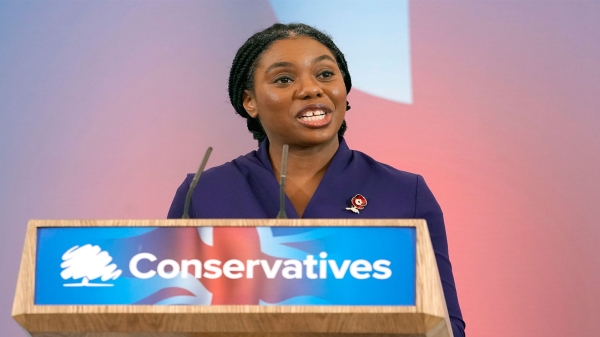
Kemi Badenoch has broken new ground by becoming the first Black woman to lead the United Kingdom’s Conservative Party, defeating her closest rival, Robert Jenrick, with 53,806 votes to his 41,388. Badenoch takes over from Rishi Sunak in the wake of a challenging election loss for the Tories and assumes the role of Leader of the Opposition against Labour’s ruling majority.
In her victory speech, Badenoch emphasized her commitment to holding the Labour government accountable and preparing the Conservative Party for future elections. “The task that stands before us is tough but simple,” she declared. “Our first responsibility as His Majesty’s loyal opposition is to hold this Labour government to account. Our second is no less important; it is to prepare for the next few years for the government.”
Badenoch’s win marks a significant milestone, as she becomes the first Black leader of a major UK political party, joining the ranks of previous female Tory leaders like Margaret Thatcher, Theresa May, and Liz Truss. The North West Essex MP, known for her outspoken, conservative approach, is determined to revive the party by embracing “first principles” that focus on individual responsibility, freedom, and less state influence.
Born to Nigerian parents in Wimbledon and raised in Lagos, Badenoch returned to the UK at 16 and quickly made a name for herself in politics. Formerly serving as Business Secretary, she has earned a reputation for her no-nonsense style, often clashing with activists and the media over issues like identity politics, gender equality, and environmental policies. Despite criticisms, she remains a favorite among Conservative Party members, many of whom view her as a bold leader unafraid to tackle complex, divisive topics.
In her campaign, titled “Renewal 2030,” Badenoch outlined her vision for a Conservative resurgence, aiming to craft a new policy platform that re-engages with disillusioned voters. She plans to conduct a series of reviews to shape the party’s policy direction and has vowed to address pressing societal concerns, from immigration to economic reform. Her straightforward stance on immigration, her desire to reduce bureaucracy, and her critiques of “woke” culture resonate with a faction of Conservatives who feel the party has drifted too far from its core values.
Prime Minister Sir Keir Starmer extended his congratulations, calling Badenoch’s victory “a proud moment for our country.” However, Labour Party chair Ellie Reeves struck a critical tone, accusing the Tories of “division” and asserting that the party under Badenoch remains “incapable of change.”
One of Badenoch’s immediate challenges will be uniting a party that has faced internal divisions and dwindling public support. She inherits a weakened Conservative Party and must rally a significantly reduced group of Tory MPs. As the sixth leader in less than nine years, she will be tasked with halting the drift of supporters to the right-wing Reform UK, led by Nigel Farage, while managing internal tensions from both conservative hardliners and centrist members.
Despite her ambitions to lead a united front, Badenoch’s history of controversial statements, including remarks about statutory maternity pay and civil servants, may spark friction. Her blunt approach, while appealing to her base, may create obstacles within the broader party as she seeks to bridge divides and position the Tories as a viable alternative to Labour.
Facing off against Starmer at weekly Prime Minister’s Questions, Badenoch will be expected to solidify her role as Leader of the Opposition, putting her on the front lines of parliamentary debates. As she begins this new chapter, her ability to navigate both party dynamics and public sentiment will shape the future of the Conservative Party and its path to potential electoral recovery.