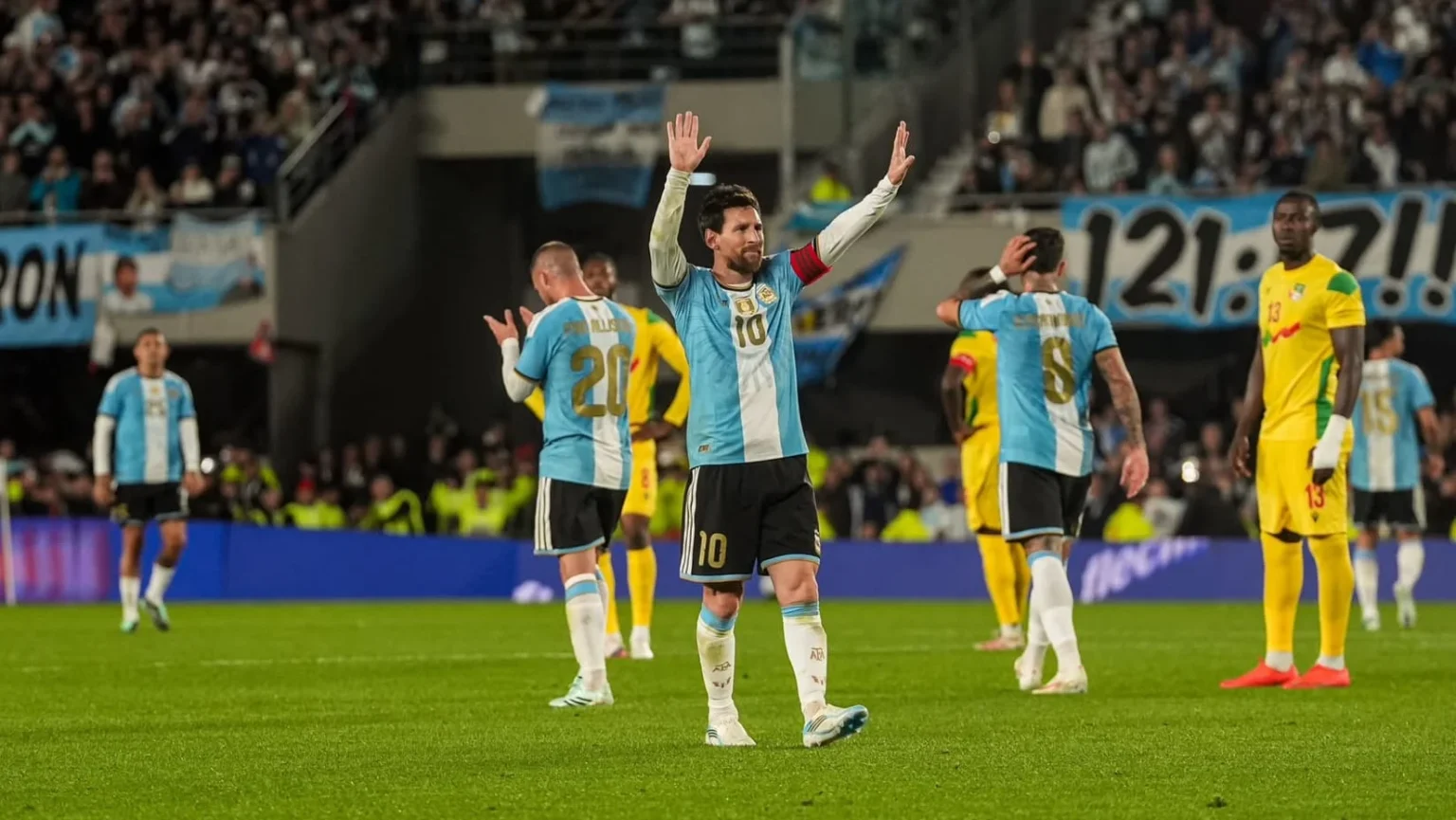
Lionel Messi brought his remarkable Argentina international career to a memorable close on Tuesday, scoring once and providing two assists as the world champions defeated Benin 3-0 at the Monumental Stadium in Buenos Aires.
The October 6 friendly marked Messi’s final appearance for Argentina, ending a 21-year international career that saw him become the country’s most-capped player and leading goalscorer.
Messi played a decisive role in all three goals.
He opened the scoring by delivering a corner that Nicolás Otamendi converted in the 48th minute. Messi then set up Nico Paz for Argentina’s second goal in the 61st minute before completing the scoring from the penalty spot 10 minutes later.
Inter Miami, Messi’s club, said he was “directly involved in each of Argentina’s goals,” describing the match as his final international appearance and noting that he finished with a goal and two assists.
More than 85,000 spectators watched the emotional farewell as Messi ended his Argentina career with 208 appearances and 126 goals, according to Reuters.
“It’s hard to talk,” Messi said after the match, according to Reuters. “There are a lot of emotions, a lot of things going through my head.”
Reflecting on his time with the national team, Messi said wearing the Argentina shirt for more than two decades had been “a huge source of pride.”
“Playing for Argentina is the most beautiful thing that can happen to you,” he added.
The farewell fixture also brought former Nigeria head coach Gernot Rohr back into the spotlight against Messi. Rohr was in charge of Benin for the match, eight years after he led Nigeria against Argentina and Messi at the 2018 FIFA World Cup in Russia.
Before Tuesday’s game, Benin goalkeeper Marcel Dandjinou insisted his team would approach the match competitively rather than simply participate in Messi’s farewell.
“This is football: eleven against eleven,” Dandjinou told Spanish newspaper Marca.
“We are not here to do tourism in Argentina, we are here to play and compete,” he added.
Dandjinou also dismissed suggestions that Benin would allow Messi to score as part of the celebration.
“I am a goalkeeper, and my role is to stop shots,” he said, adding that if Messi took a penalty, he would attempt to save it.
“Nobody has told us that we have to give him a goal,” Dandjinou said.
Benin defender Mohamed Tijani, meanwhile, took a more relaxed approach to facing the Argentine captain.
“We won’t be marking Messi,” Tijani told C5N, according to Goal.com. “We’ll just enjoy this match.”
Rohr described the occasion as a major honor for Benin and for him personally.
“Yes, it’s a big honor for us and also for me like a coach to play this last game of Leo Messi in his national team,” he told Footy-Africa.
The match ultimately belonged to Messi, who signed off his Argentina career by contributing to every goal and helping the world champions secure a 3-0 victory.
After more than 20 years in the national-team shirt, Argentina’s greatest goalscorer and most-capped player bowed out on his own terms—with a goal, two assists and another memorable victory.