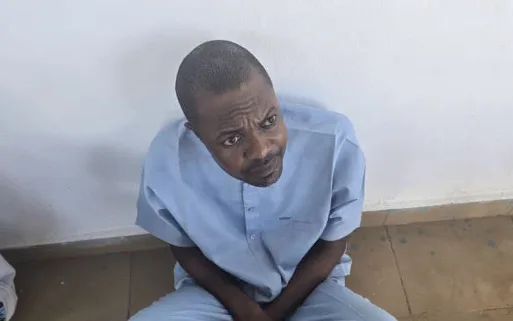
Police have arrested Adeniyi Adeyemi, the self-acclaimed Director-General of the controversial Presidential Foreign Intervention Promotion Council (PFIPC), in Osun State after a Federal High Court in Abuja issued a warrant for his arrest.
Adeyemi was apprehended by operatives of the Nigeria Police Force’s Intelligence Response Team (IRT) at a hideout in a village in Ijesaland, Osun State, according to security sources. The operation reportedly followed a five-day surveillance conducted by the Department of State Services (DSS) before the investigation was handed over to the police.
The spokesperson of the Osun State Police Command, Abiodun Ojelabi, confirmed the arrest, stating that the suspect had been taken into custody and was being transported to Abuja to face prosecution.
The arrest came only hours after Justice Mohammed Umar of the Federal High Court granted an application by the prosecution for a bench warrant against Adeyemi over his repeated failure to appear in court.
Adeyemi is expected to answer an eight-count charge bordering on alleged forgery, fraud, and impersonation in a case marked FHC/ABJ/CR/562/2025.
During proceedings, police counsel Wisdom Madaki informed the court that the defendant had consistently failed to appear despite multiple adjournments.
According to the prosecution, the matter had come before the court five times, with all previous delays attributed to the defendant’s absence. Citing provisions of the Administration of Criminal Justice Act (ACJA), the prosecution urged the court to authorize his arrest.
The application was opposed by Adeyemi’s counsel, Genesis Francis, who argued that his client stayed away from court because of concerns over his personal safety.
The defence maintained that Adeyemi had appeared in court during an earlier hearing and claimed that increasing public attention surrounding the case had exposed him to serious security threats.
After hearing both parties, Justice Umar ruled in favour of the prosecution, noting that although the case was filed in late 2025, the defendant had appeared only once and had subsequently failed to attend four consecutive court sessions.
The court consequently ordered security agencies to arrest Adeyemi and produce him before the court on September 30 for arraignment.
Among the prosecution’s proposed witnesses are Chief of Staff to the President, Femi Gbajabiamila, senior government officials, police officers, and personnel from the Office of the Accountant-General of the Federation.
Before his arrest, Adeyemi had publicly denied evading law enforcement, insisting that he had withdrawn from public view because of alleged attempts on his life.
In a television interview earlier this week, he maintained that he was prepared to face trial but feared for his safety. He also repeated his controversial claim that he paid ₦400 million to secure his appointment as Director-General of the PFIPC, alleging that individuals who financed the payment later petitioned the Economic and Financial Crimes Commission (EFCC) after disputes arose.
Police investigations allege that Adeyemi and his associates forged appointment letters and official government documents to portray the PFIPC as a legitimate federal agency.
The investigation began after the Office of the Chief of Staff to the President petitioned the Inspector-General of Police over reports that forged documents bearing fake signatures, official seals, reference numbers, and the Nigerian Coat of Arms were being used to appoint individuals into the purported council.
Investigators also allege that Adeyemi operated from an office within the Federal Secretariat Complex in Abuja while presenting himself as the Director-General of the council.
The case has also been linked to the death of Dolapo Babatunde Tanimola, an individual alleged to have played a key intermediary role in the operation before dying in a hotel fire in Abuja.
Despite the allegations, Adeyemi has continued to insist that the PFIPC is a legitimate entity. In an open letter to President Bola Tinubu, he called for the establishment of an independent investigative panel to examine the controversy surrounding the council and the alleged ₦1.3 billion budget allocation reportedly included for it in the 2026 Appropriation Bill.
He proposed that the panel include representatives from civil society organisations, the Nigerian Bar Association, international financial institutions, diplomatic missions, human rights organisations, the Independent Corrupt Practices and Other Related Offences Commission (ICPC), and the EFCC, pledging to provide documentary evidence to support his claims.