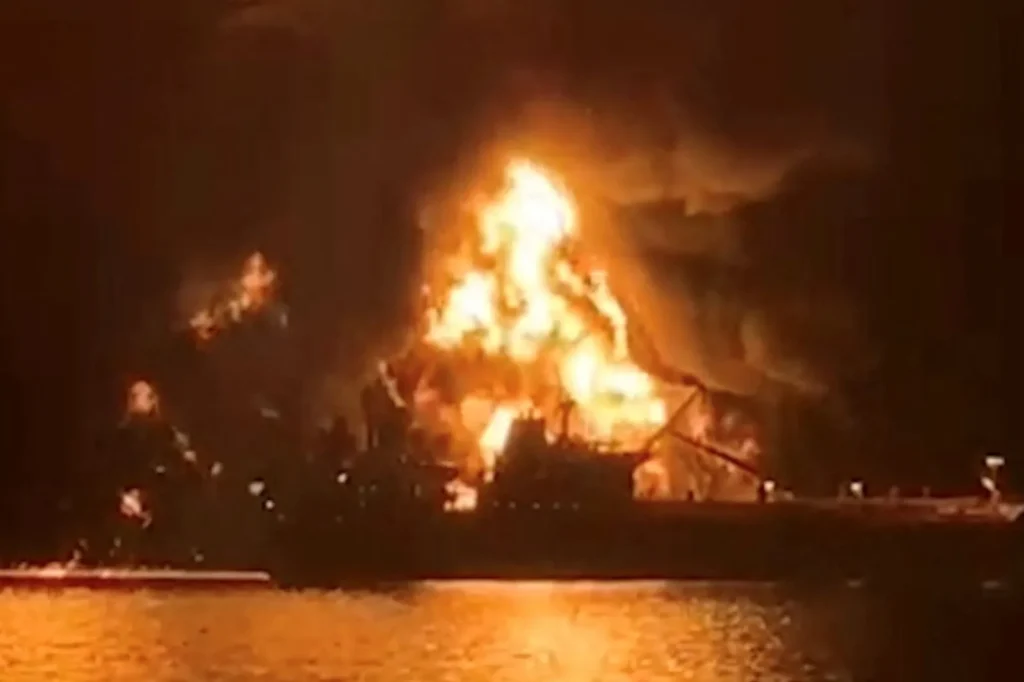
Two oil tankers and a tugboat have reportedly caught fire in the strategic Strait of Hormuz, following a series of attacks on commercial vessels in the vital international shipping corridor.
Iranian media reported early Thursday, citing the Islamic Revolutionary Guard Corps (IRGC), that one of the tankers struck a mine, triggering a fire. The cause of the blaze on the second tanker was not immediately established.
According to the Fars news agency, a tugboat approached the burning vessels to assist with firefighting operations but subsequently caught fire itself.
The reports have not been independently verified, and details surrounding the condition of the vessels and their crews remain unclear.
The incident comes amid growing insecurity in the Strait of Hormuz, one of the world’s most important maritime routes for transporting crude oil and natural gas.
The United States has repeatedly accused Iran of targeting commercial shipping in the region, while maritime security concerns have intensified following a sharp increase in reported attacks on vessels.
BBC Verify’s analysis of data from the United Kingdom Maritime Trade Operations (UKMTO) agency showed that 12 vessels were attacked between October 5 and 11, representing the highest weekly number of reported strikes since the US-Israeli war with Iran began.
The previous week recorded 10 attacks, while six vessels reportedly came under attack on a single Sunday, marking the highest number of incidents recorded in one day.
The increasing attacks have also slowed the recovery of oil shipments through the waterway, despite efforts by the United States and regional partners to protect commercial vessels.
Experts say Iran has intensified attacks to strengthen its influence over the strategic waterway, particularly as American forces increase naval escorts for tankers navigating the southern section of the strait.
The attacks have also extended beyond the immediate vicinity of the Strait of Hormuz.
One incident involved the Nicaragua-flagged tanker Petro Dolphin, which was reportedly struck by a drone near the Sohar Anchorage in Oman, more than 250 kilometres from the strait.
Footage verified by BBC showed the vessel engulfed in flames. Eleven Indian sailors were rescued, while two others remained missing, according to the Forward Seamen’s Union of India.
In another incident, the container ship GFS Pride sank on Tuesday after being struck by an unidentified projectile in the strait. All 21 crew members were reportedly evacuated safely.
Iran’s Islamic Revolutionary Guard Corps subsequently released footage showing what appeared to be the vessel sinking, claiming it was carrying 2,500 containers of contraband and had taken an unauthorised route.
Despite the security concerns, the US military’s Central Command maintained that commercial shipping continued through the waterway under coordinated protection from American forces and regional partners.
US Navy data also indicated that the number of vessels receiving assistance to navigate the Strait of Hormuz during the first 10 days of October increased by 85 per cent compared with the same period in August.
Meanwhile, Gulf oil exporters have increasingly relied on a shuttle system in which smaller tankers transport crude through the strait before transferring their cargo to larger vessels in the Gulf of Oman.
The vessels generally navigate close to Oman’s coastline, a route Iran has described as unauthorised, insisting that ships should instead use an alternative passage closer to its own shores.
The latest reported fires underscore growing concerns over maritime security, global energy supplies and the potential economic consequences of continued attacks in one of the world’s most critical shipping corridors.