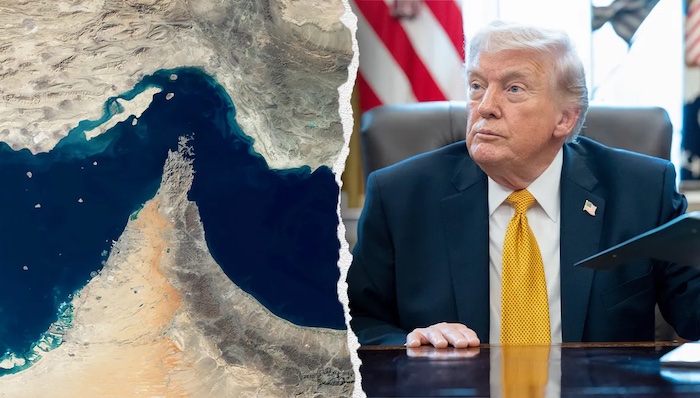
President Donald Trump has announced a renewed US naval blockade of Iranian ports and unveiled a 20 per cent charge on cargo passing through the Strait of Hormuz, marking a sharp escalation in tensions between Washington and Tehran amid renewed military confrontations in the Gulf.
According to Trump, the new measures will take effect at 16:00 Eastern Time (20:00 GMT) on Tuesday. He said the United States would assume responsibility for safeguarding the strategic waterway while ensuring unrestricted access for other nations.
In a post on Truth Social, Trump stated that all cargo transiting the Strait of Hormuz would be subject to a 20 per cent charge. He added that the renewed blockade would prevent Iranian vessels and ships linked to Iranian customers from entering or leaving the waterway, while maintaining free passage for other countries.
The announcement followed overnight military exchanges between the United States and Iran.
The US Central Command said it launched strikes against several Iranian military targets, including air defence systems, coastal radar sites, missile launch facilities, drone infrastructure, a submarine facility and a naval maintenance base. The military said the operation was carried out in response to Iranian attacks on commercial vessels navigating the Strait of Hormuz.
Iran, however, said it responded by launching strikes on US military installations in Kuwait, Jordan and Bahrain, as well as radar facilities in Oman.
Iranian Foreign Minister Abbas Araghchi dismissed Trump’s declaration that the United States would become the protector of the Strait of Hormuz, insisting that Iran had long been responsible for securing the strategic passage.
He argued that any country providing safe navigation through the waterway should be compensated for that role.
Prior to Trump’s announcement, Iran’s military had warned that it would resist any attempt by the United States to interfere in the management of the Strait of Hormuz.
Despite the renewed hostilities, commercial shipping continued through the waterway on a limited scale, although vessel traffic remained significantly below normal levels, according to ship-tracking platform MarineTraffic.
The Strait of Hormuz remains one of the world’s most critical maritime corridors, carrying a substantial portion of global crude oil exports. Any disruption to shipping in the region has historically triggered volatility in global energy markets and heightened concerns over international supply chains.