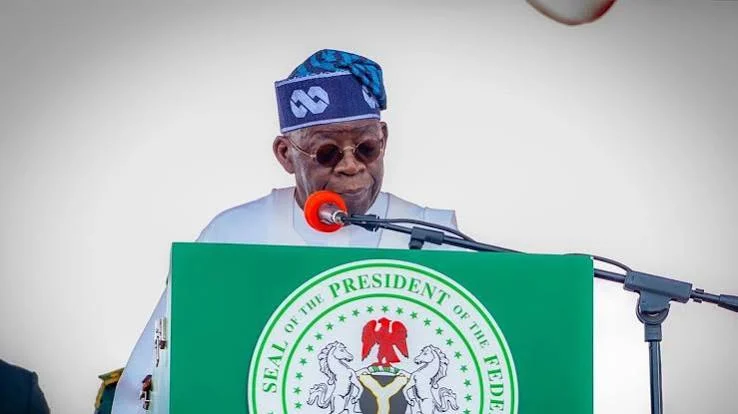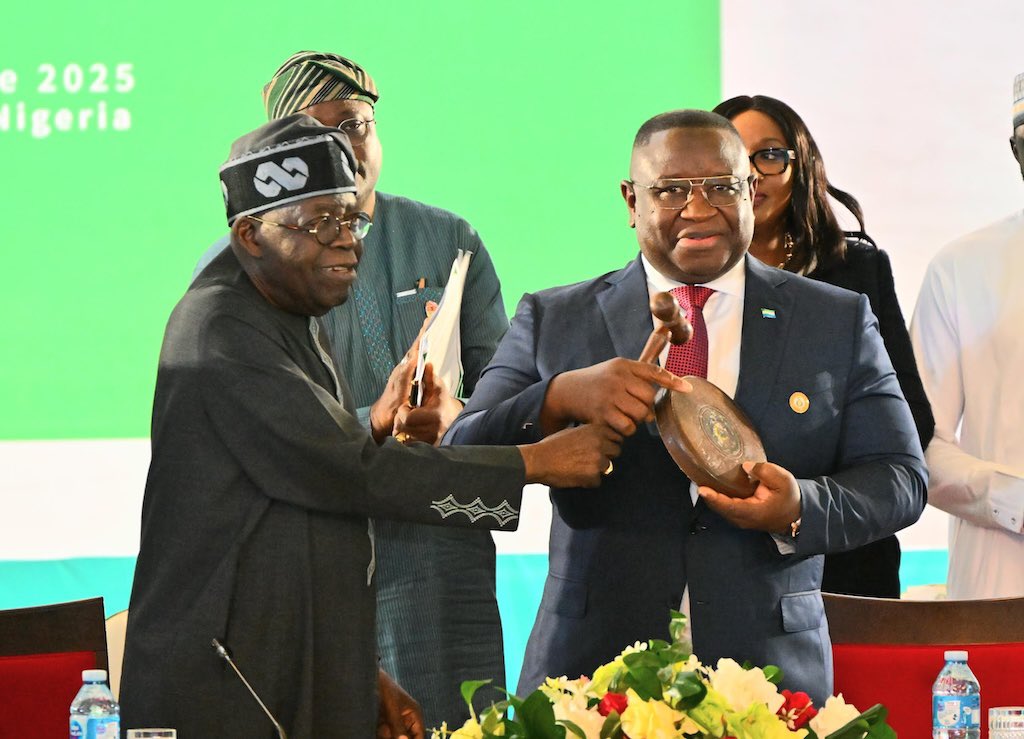
President Bola Ahmed Tinubu on Sunday officially concluded his tenure as Chairperson of the Authority of Heads of State and Government of the Economic Community of West African States (ECOWAS), passing the baton to President Julius Maada Bio of Sierra Leone during the 67th Ordinary Session held at the Aso Rock Villa, Abuja.
In his farewell speech, President Tinubu expressed deep gratitude for the opportunity to lead the regional bloc, describing the role as an honour and a source of profound fulfilment. “I now hand over the mantle of leadership to my great friend and dear brother, His Excellency, President Julius Bio of Sierra Leone,” he said.
As part of his final address, Tinubu reiterated his call for the immediate operationalisation of the ECOWAS Standby Force, a regional initiative proposed to combat escalating terrorism and cross-border crimes in West Africa. “I am a little bit worried about the slow pace of its activation, which is taking longer than desired,” he said, urging leaders to move from planning to execution.
First proposed in April 2024, the Standby Force initiative is part of a broader plan to combat insecurity in the Sahel region. It includes a proposed Regional Counter-Terrorism Centre to serve as a hub for intelligence-sharing, operational coordination, and capacity building across ECOWAS member states.
Tinubu, who assumed ECOWAS leadership in July 2023, cited several structural and strategic achievements under his chairmanship. Notably, he announced the completion of the ECOWAS Military Logistics Depot in Lungi, Sierra Leone—a key facility expected to support deployment logistics across the region.
In a review of his two-year leadership, Tinubu acknowledged challenges, particularly in maintaining unity within the bloc. He referenced the exit of Burkina Faso, Mali, and Niger following military takeovers but expressed optimism that ongoing diplomatic efforts would eventually bring them back into the ECOWAS fold.
On economic matters, Tinubu called for deeper regional integration. “Our intra-regional trade remains low despite our enormous potential,” he said, advocating for reduced trade barriers, stronger private sector engagement, and acceleration of infrastructure projects like the West African Gas Pipeline and Abidjan–Lagos Corridor Highway.
Accepting the leadership, President Bio thanked Tinubu for his “steadfast leadership” and pledged to build on the foundation of peacebuilding and regional dialogue laid during the outgoing chair’s tenure. He acknowledged the current complex challenges across the region, including democratic instability, terrorism, and youth disillusionment.
“The democratic space is under strain in parts of our region… Citizens—especially our youth—are demanding not just elections, but accountability and a fair stake in national life,” President Bio said, promising to prioritise regional unity and cooperation during his tenure.
The handover comes at a critical time for West Africa, as the region continues to grapple with political transitions, economic strain, and growing threats of extremism and armed conflict.