The United States and Iran have exchanged a new wave of military strikes, deepening tensions across the Middle East after two American soldiers were killed in a missile and drone attack on US forces in Jordan.
The latest confrontation marks the eighth consecutive night of hostilities between the two countries, further weakening prospects for restoring a ceasefire agreement that collapsed earlier this month.
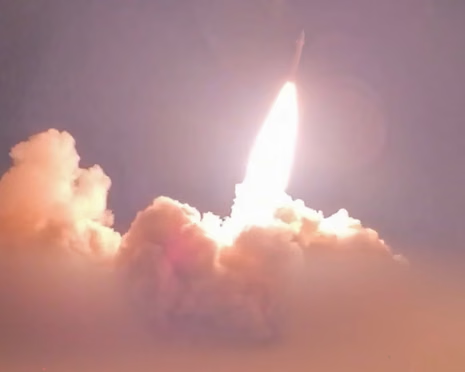
According to the United States Central Command (CENTCOM), American forces launched airstrikes against Iranian coastal surveillance systems, air defence installations, and units linked to the Islamic Revolutionary Guard Corps (IRGC), which Washington accused of carrying out the attack that killed US troops in Jordan.
CENTCOM said the operation was aimed at reducing Iran’s ability to threaten commercial vessels in the strategic Strait of Hormuz and holding accountable the IRGC forces responsible for attacks against American personnel.
Iranian state media reported that Qeshm Island, a key location in the Strait of Hormuz, was among the areas targeted in the US strikes.
In response, Iran’s military announced drone attacks against two US military facilities in Kuwait — Camp Udairi and Ali Al Salem Air Base. The IRGC-linked Tasnim news agency described the operation as a large-scale assault involving explosive drones.
Earlier, CENTCOM confirmed that two US service members were killed while American and allied forces defended against Iranian ballistic missile and drone attacks in Jordan. Another US service member remains missing.
US Defence Secretary Pete Hegseth paid tribute to the fallen troops, describing their sacrifice as a reason for the military to remain determined. The latest deaths bring the number of American military fatalities in the conflict to 16, including a Navy pilot previously reported missing who was later confirmed dead.
Meanwhile, Iran’s Health Ministry said at least 50 people have been killed and more than 500 others injured in US strikes carried out over the past three weeks.
The renewed violence follows a failed ceasefire agreement reached less than a month ago between Washington and Tehran. Both sides have accused each other of violating the deal, leading the United States to restore its blockade of Iranian ports while Tehran announced the closure of the Strait of Hormuz.
The two nations have also traded accusations over attacks on civilian infrastructure. The US maintains that its operations have focused only on military targets and logistical facilities, while Iran claims American strikes damaged bridges and transportation networks. Kuwait has also accused Iran of targeting a power plant and a water desalination facility.
International humanitarian law prohibits attacks on civilians and civilian infrastructure unless such sites are being used for military purposes.
Iran’s Supreme Leader Mojtaba Khamenei on Saturday accused Washington of repeatedly violating the failed ceasefire agreement, claiming that the actions of the US administration had damaged trust in diplomatic commitments.
The escalating confrontation has raised concerns among regional governments and international observers over the possibility of a wider conflict in the Middle East.