In a deeply alarming and rapidly escalating situation, thousands of lives have been lost in the Israel-Gaza conflict, and the death toll shows no signs of slowing down, five days after Palestinian militants launched a surprise attack on Israel. Israel, in response, initiated a massive shelling campaign in the Gaza Strip.
The situation began when Palestinian militants launched an unexpected assault on Israel on the Jewish holiday of Simchat Torah. This attack came exactly 50 years and a day after the outbreak of the 1973 Arab-Israeli war. The Iran-backed Hamas militants fired thousands of rockets from Gaza into Israel and used explosives and bulldozers to breach the security fence surrounding the Palestinian enclave. Using a range of vehicles, including motorbikes, pickup trucks, motorized gliders, and speed boats, the militants infiltrated Israel, targeting cities such as Ashkelon, Ofakim, and Sderot.
One of the most horrifying incidents was the massacre at a music festival near Kibbutz Reim, near Gaza. Here, Hamas took around 150 hostages, including at least 11 Thais, two Mexicans, and an unknown number of Americans and Germans.
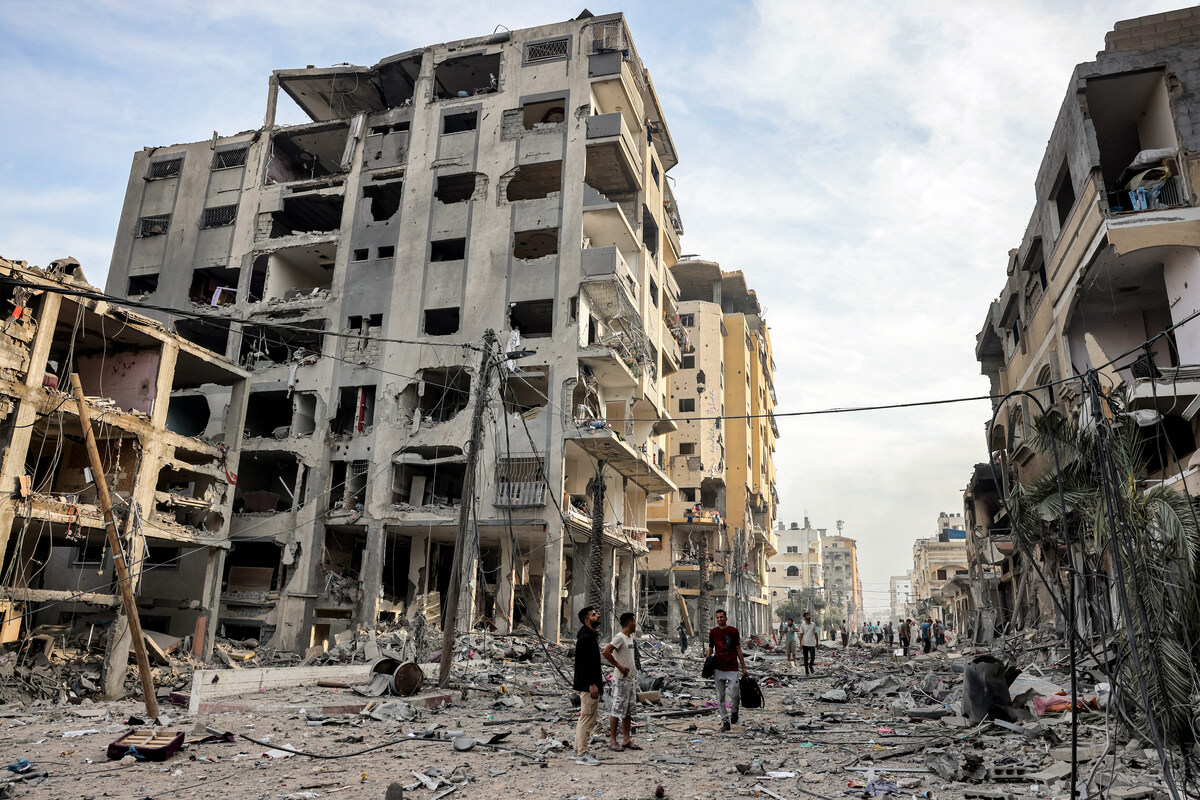
In response, Israel declared war on Hamas and unleashed a relentless campaign of airstrikes on Gaza. Defense Minister Yoav Gallant ordered a complete siege of Gaza, with devastating consequences, including a severe shortage of electricity, food, water, and gas. The military mobilized tens of thousands of troops and heavy armor near Gaza and called up 300,000 reservists for a campaign named “Swords of Iron.” Prime Minister Benjamin Netanyahu has promised to reduce Hamas’s hideouts in Gaza to rubble.
As of Tuesday evening, the United Nations reported that over 260,000 people were forced to flee their homes in Gaza, a territory with 2.3 million people that has been under an Israeli-Egyptian blockade for more than 15 years. Israel announced that it had mostly reclaimed the embattled south and the border around Gaza but faced ongoing clashes in the southern city of Ashkelon. Israel also faced the threat of a multi-front war, with tensions escalating on its northern border with Lebanon and skirmishes with forces in Syria.
The death toll from the conflict has surpassed 3,600, including Israeli and Palestinian civilians, soldiers, and combatants. According to Israel, more than 1,200 people have been killed and over 2,700 wounded in Israeli cities, towns, and kibbutz communities. At the Supernova music festival near Kibbutz Reim, approximately 270 people were killed. On the Gaza side, health officials reported 900 people dead and more than 4,000 wounded.
Hamas, in response to Israeli air strikes, claimed that “four of the enemy’s prisoners” had been killed, although this could not be independently verified. Tragically, eight Palestinian journalists were also killed in Israeli air strikes.
The conflict has not been limited to the Gaza Strip; unrest has erupted in the occupied West Bank, leading to the deaths of 15 Palestinians.
Hamas has launched a substantial offensive it termed “Operation Al-Aqsa Flood,” firing 5,000 rockets. The organization has threatened to kill hostages every time Israel targets a civilian site without warning, making negotiations for a prisoner swap unlikely.
In response to the situation, the United States has expressed “rock-solid and unwavering” support for Israel. President Joe Biden condemned Hamas’s attacks as “sheer evil” and has pledged increased assistance to Israel, including missiles for its Iron Dome interceptor system. International leaders, including those from the United States, Britain, France, Germany, and Italy, condemned the attack and expressed full support for Israel, highlighting their recognition of the legitimate aspirations of the Palestinian people.
As the world watches in shock and concern, Iran celebrates the Hamas assault, despite denying any involvement. Meanwhile, Lebanon’s Hezbollah, a Hamas ally, has launched projectiles into northern Israel, leading to further hostilities in the region. International efforts to de-escalate the situation are now of paramount importance as the death toll continues to rise, and the region remains engulfed in violence.