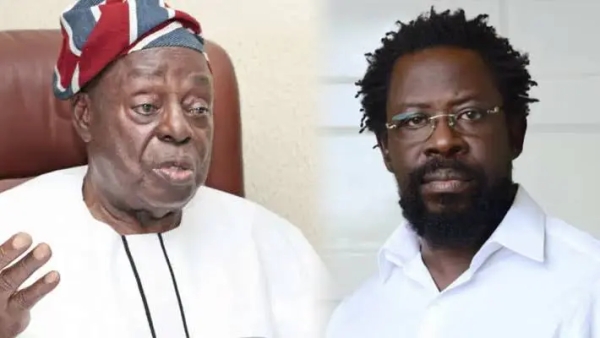
Renowned Nigerian legal luminary, Afe Babalola, SAN, has issued a firm response to public uproar following the defamation case against Dele Farotimi, a human rights advocate. Babalola emphasized that the prosecution would proceed unhindered by social media campaigns or public protests.
The controversy began when Farotimi, in his book Nigeria and its Criminal Justice System, allegedly made defamatory claims against Babalola. The police command in Ekiti arrested Farotimi in Lagos on Tuesday, acting on a petition accusing him of defamation and cyberbullying. The arrest followed weeks of speculation, with Farotimi alleging that officers had attempted to lure him into custody under questionable circumstances.
Court Proceedings and Social Media Outcry
On Wednesday, Farotimi appeared before the Ekiti State Magistrate Court in Ado-Ekiti on a 16-count charge, pleading not guilty to all accusations. The court ordered his remand, igniting widespread public and political reaction.
Prominent figures, including former presidential candidates Peter Obi and Atiku Abubakar, have called for Farotimi’s release. Meanwhile, Omoyele Sowore, activist and Sahara Reporters publisher, urged Nigerians to join a nationwide protest against the judiciary for what he described as “an assault on human rights.”
Afe Babalola’s Statement
In a detailed statement released by Afe Babalola & Co., the law firm representing Babalola, the senior advocate defended the decision to pursue legal action. The statement, signed by Adebayo Adenipekun, SAN, dismissed claims that the case was politically motivated or an attempt to suppress free speech.
“If we do not take any action to correct the false, reckless, and malicious statements by this author, our silence will necessarily be interpreted as an admission of guilt,” the statement read.
Babalola stressed that while freedom of speech is a fundamental right, it is not without accountability. “The constitution recognises fundamental human rights, but these rights are not absolute; the freedom to speak is not freedom from the consequences of speech.”
Commitment to Justice
The statement reaffirmed Babalola’s belief in the Nigerian justice system, highlighting his law firm’s six-decade history of defending human rights and upholding the rule of law.
“Unlike him, we believe in the justice delivery system every time—not only when it favours us,” the statement continued. “At the end of this process, only the law will matter—not the media tactic or street yelling.”
Moving Forward
The firm clarified that it would not debate the merits of the case or its evidence in public, underscoring that the matter was sub judice. Instead, it expressed confidence in the courts to deliver a fair and just outcome.
Farotimi retains the option to contest the charges through due legal process, but Babalola’s firm has signaled its determination to pursue the case to its conclusion.
This high-profile legal battle underscores the delicate balance between freedom of expression and the legal boundaries of defamation in Nigeria. As the case unfolds, it is set to test the nation’s judicial processes and public opinion on accountability in speech.