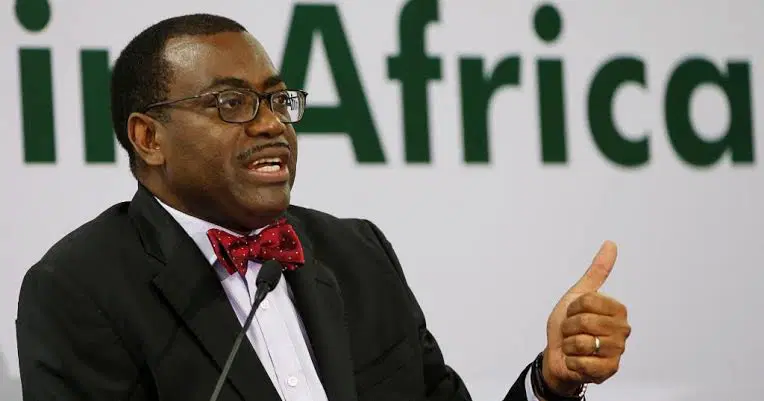
Outgoing President of the African Development Bank (AfDB), Dr. Akinwumi Adesina, has called for urgent and large-scale investments to address Africa’s energy deficit, revealing that 600 million people on the continent still lack access to electricity despite its vast renewable energy resources.
Speaking at the 2025 Standard Chartered Bank Africa Summit held recently in Lagos, Adesina painted a stark picture of the continent’s development challenges while highlighting the enormous opportunities that could be unlocked through strategic investment.
“Africa is home to some of the largest sources of renewable energy in the world,” Adesina said. “We have 11 terawatts of solar, 350 gigawatts of hydro, 150 gigawatts of wind, and 15 gigawatts of geothermal potential. Yet, millions remain in the dark.”
Adesina emphasized that tapping into these renewable energy sources could power a new era of industrial growth across the continent, driving economic competitiveness and unlocking value in agriculture, minerals, and metals.
To help close the massive energy access gap, Adesina highlighted “Mission 300”, a joint initiative by the AfDB and the World Bank, which aims to connect 300 million Africans to electricity by 2030. Achieving this ambitious goal, he said, would require a combination of public and private sector investments, with initial projections for the first 12 participating countries requiring $127 billion—$61 billion of which is expected from the private sector.
To mobilize such capital, Adesina urged the expansion of public-private partnerships and the creation of mechanisms for generating bankable project pipelines to attract sustainable financing.
On a broader scale, Adesina noted that for Africa to meet the United Nations Sustainable Development Goals (SDGs) by 2030, it would need an estimated $1.3 trillion annually to finance critical infrastructure, energy systems, digital connectivity, transport networks, healthcare, education, and water and sanitation systems.
“This will require mobilising capital from multiple channels—domestic resource mobilisation, capital markets, private sector investments, concessional finance, and foreign direct investment,” he stated.
Adesina also called for a shift from reliance on foreign aid to a bold investment-driven approach. “To achieve faster and more stable economic growth, Africa must move away from aid to investment to unlock its vast assets,” he added.
He concluded with an optimistic note, saying Africa has the resources, resilience, and readiness to realize its full potential—if it can attract and manage the capital needed to light up its future.