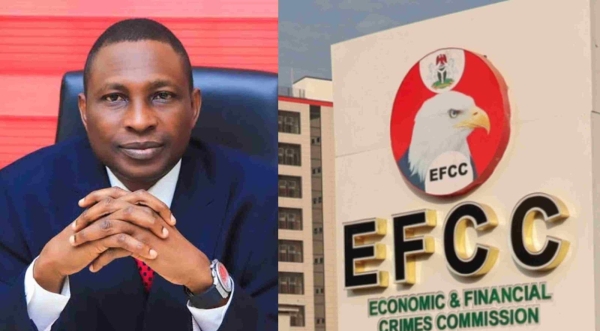
A Federal High Court in Abuja has granted the Economic and Financial Crimes Commission (EFCC) approval to freeze 24 bank accounts across multiple banks in connection with allegations of terrorism financing and money laundering.
Justice Emeka Nwite issued the order on Monday following an ex-parte application presented by EFCC counsel, Martha Babatunde. The accounts, owned by Lawrence Lucky Eromosele, are under investigation for alleged links to kidnapping and other unlawful activities. The court allowed the accounts to be frozen for 90 days, pending the completion of investigations.
Legal Proceedings and Evidence
The motion, marked FHC/ABJ/CS/1897/V/2024, was filed by Senior Advocate of Nigeria (SAN) Ekele Iheanacho. He requested the freeze order to preserve funds suspected to be connected to terrorism and money laundering.
In the affidavit supporting the motion, EFCC investigator Mohammed Khalil detailed that the accounts were linked to a syndicate involved in using virtual cryptocurrency exchange platforms to launder proceeds of illegal activities and manipulate the naira’s value.
Khalil, part of the Special Investigation Team operating under the Office of the National Security Adviser (ONSA), disclosed that the investigation was initiated following a directive from National Security Adviser Nuhu Ribadu.
Threats and Ransom Demands
The affidavit further revealed that the syndicate had issued direct threats against senior ONSA operatives and their families. The perpetrators reportedly provided detailed information about the operatives’ home addresses, family movements, and daily routines, demanding ransom payments.
Khalil stated that one operative received a chilling chat message, marked as Exhibit EFCC 1, from an unknown individual threatening their family’s safety unless a payment was made.
“Preliminary investigations identified Lawrence Lucky Eromosele as one of the individuals behind these threats,” Khalil noted, adding that the identified bank accounts were crucial to funding criminal and terrorist activities. Bank statements linked to the accounts were submitted as Exhibit EFCC 2.
Court’s Decision
During the hearing, Justice Nwite inquired about the investigation timeline, to which Babatunde responded that the EFCC would conclude within 90 days.
Granting the EFCC’s request, Justice Nwite ordered the accounts to remain frozen and adjourned the case to March 24, 2025, for further mention.
Implications for National Security
The freeze order represents a significant step in the government’s efforts to combat terrorism financing. The EFCC’s investigation aims to disrupt the syndicate’s financial network, which allegedly supports criminal and terrorist activities across the country.
The case underscores the growing reliance of criminal organizations on digital financial platforms, highlighting the need for enhanced surveillance and regulation of cryptocurrency exchanges in Nigeria.