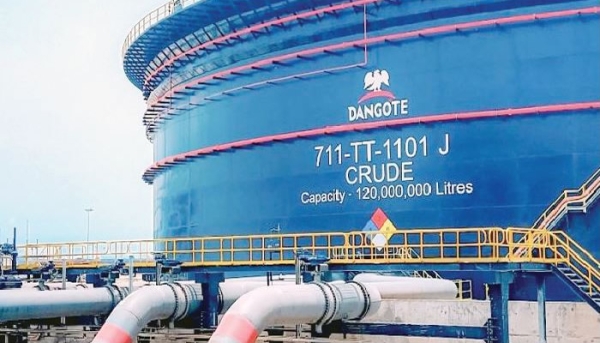
The Dangote Petroleum Refinery, Africa’s largest oil refinery, has officially begun exporting refined petroleum products to neighboring West African countries, signaling a potential transformation in regional fuel markets.
According to a report by Bloomberg on Tuesday, corroborated by data from Vortexa, Kpler, Precise Intelligence, and ship-tracking platforms, a shipment of gasoline was recently dispatched from the refinery to waters off Togo’s coast. The cargo, transported aboard the vessel CL Jane Austen, reportedly contained over 300,000 barrels of gasoline.
Regional Impact and Trade Prospects
The move comes as countries in West Africa increasingly look to the refinery to reduce their dependence on more expensive fuel imports from Europe. For instance, Ghana is actively exploring the possibility of sourcing petroleum products from the Dangote Refinery.
Speaking at the OTL Africa Downstream Oil Conference in Lagos last month, Mustapha Abdul-Hamid, chairman of Ghana’s National Petroleum Authority (NPA), revealed that importing fuel from Nigeria rather than Europe could save Ghana up to $400 million monthly and significantly lower freight costs.
“If the refinery reaches its full capacity of 650,000 barrels per day (bpd), Nigeria cannot consume all of that volume alone. It would be much easier and more cost-effective for Ghana to import from Nigeria,” Abdul-Hamid explained.
Expanding Market Reach
In addition to Ghana, several African nations, including South Africa, Angola, and Namibia, are reportedly in advanced negotiations to begin importing fuel from the refinery. Other nations, such as Niger, Chad, Burkina Faso, and the Central African Republic, have initiated discussions about similar arrangements.
A source close to the refinery’s management confirmed these developments, stating, “Talks are at an advanced stage with Ghana, Angola, Namibia, and South Africa, while initial discussions are ongoing with Niger, Chad, Burkina Faso, and the Central African Republic.”
Strategic Fuel Transfers
The report also highlighted that the shipment to Togo is currently floating off the coast of Lomé, a hotspot for ship-to-ship fuel transfers. While the gasoline’s final destination remains uncertain, the move signals a significant ramp-up in the refinery’s production capabilities and its intent to become a key supplier in the region.
Last month, the refinery shipped its first seaborne gasoline cargo to Lagos, Nigeria’s commercial hub, marking another milestone in its operations.
Domestic and Global Implications
The Federal Government of Nigeria recently ended the state-owned Nigerian National Petroleum Corporation’s (NNPC) monopoly on purchasing fuel from the refinery, opening up opportunities for both domestic and international buyers. However, Nigeria continues to allow fuel imports from Europe and the United States under current regulatory frameworks.
While a Dangote spokesperson declined to comment, industry analysts note that the refinery’s capacity to produce and export fuel at scale could disrupt regional fuel dynamics.
“Although the shipment is small by global standards, it signals the refinery’s growing production and its potential to export significant volumes of gasoline, which could reshape fuel markets across West Africa,” a source noted.
As the refinery scales operations, all eyes will be on its ability to balance domestic demand with its ambitious export goals, potentially establishing it as a cornerstone of Africa’s energy infrastructure.