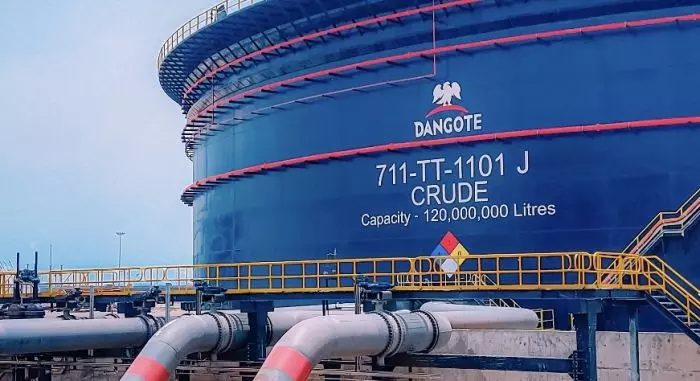
The Dangote Petroleum Refinery has announced an increase in the price of Premium Motor Spirit (PMS), commonly known as petrol, citing the rising cost of crude oil in the global market.
In a statement released on Friday, the refinery disclosed that the new price for bulk buyers purchasing between 2 million and 4.99 million litres is set at ₦955 per litre. For bulk purchases exceeding 5 million litres, the price has been adjusted to ₦950 per litre.
This revision represents a 6.17% increase (₦55.5 per litre) from the discounted rate of ₦899.50 per litre, which was offered during the December 2024 holiday period. The new rates took effect from 5:30 PM on the announcement day, impacting unsold stock balances and pending orders.
Global Oil Price Surge
The refinery attributed the price hike to a significant rise in crude oil prices. Nigeria’s Bonny Light crude, for instance, increased by 5.1% to $82 per barrel, up from $78 per barrel. According to the Organisation of Petroleum Exporting Countries (OPEC), market instability and uncertainties have driven the price surge, a trend expected to persist into 2025.
Impact on the Market
The announcement triggered a rush among motorists and fuel buyers in Lagos and surrounding areas, with many filling stations reportedly raising their pump prices in response. Some stations were already selling petrol at over ₦1,000 per litre, exacerbating concerns among consumers.
Government and Industry Reactions
Senator Heineken Lokpobiri, Minister of State for Petroleum Resources (Oil), emphasized the deregulated nature of Nigeria’s downstream sector, stating that petrol prices will now fluctuate in line with global crude oil prices.
“The essence of deregulation is for prices to find their natural levels,” Lokpobiri said at the inaugural meeting of the Petroleum Industry Stakeholders Forum (PISF) in Abuja. He noted that the government is primarily focused on quality control, availability, and ensuring accurate dispensing at retail stations.
Lokpobiri also addressed concerns over price disparities, pointing out that competition in the market has reduced the likelihood of supply shortages. “During the Christmas season, petrol prices varied across filling stations, but there were no queues. That’s the benefit of competition,” he added.
Industry Insights
Huub Stockman, Chairman of the Major Energy Marketers Association of Nigeria (MEMAN), clarified that while crude oil prices influence petrol pump prices, the effect may not be immediate.
“Crude and product prices don’t always directly correlate. It’s not automatic that a change in crude oil price leads to immediate adjustments in all derivative products. However, there is typically some correlation over time,” Stockman explained.
Looking Ahead
With the global oil market facing continued volatility, the Nigerian government and industry stakeholders are tasked with balancing price fluctuations, supply stability, and consumer protection. As petrol prices approach ₦1,000 per litre in some locations, consumers and businesses alike brace for the economic ripple effects of these adjustments.
The remains of the policy discussions and its impacts will likely shape Nigeria’s energy landscape in the coming months.