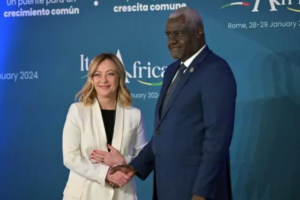
In a landmark summit held in Rome on Monday, African leaders gathered to witness Italian Prime Minister Giorgia Meloni present her much-anticipated Mattei Plan. The comprehensive initiative aims to position Italy as a crucial energy hub and concurrently address migration challenges through strategic collaborations with African nations.
Prime Minister Meloni, a far-right leader who assumed office in 2022 with a focus on anti-migrant policies, is set to reshape Italy’s relations with African countries. Inspired by Enrico Mattei, the founder of Italy’s state-owned energy giant Eni, Meloni envisions a “non-predative” approach to foster mutually beneficial partnerships.
The Mattei Plan outlines Italy’s ambition to become a pivotal bridge connecting Africa and Europe. The plan involves channeling energy resources northward while facilitating investments in the south, with the ultimate goal of curbing migration through diplomatic agreements.
“The objective is to present to African countries our vision of African development. This means a new, non-predatory, non-paternalistic approach… a peer-to-peer approach to grow together,” stated Prime Minister Meloni in an interview with national broadcaster Rai.
The summit, named “A Bridge for Common Growth,” saw representatives from over 25 countries, including European Commission President Ursula von der Leyen and dignitaries from United Nations agencies and the World Bank, gather at the Italian senate. African leaders in attendance included the Chair of the African Union Commission, Moussa Faki Mahamat, and presidents from Tunisia, Senegal, Republic of Congo, Eritrea, Ghana, Kenya, Mauritania, Mozambique, and Zimbabwe.
Italy, holding the G7 presidency this year, is emphasizing African development as a central theme to enhance its influence on a continent where global powers like China, Russia, India, Japan, and Turkey have been expanding their political presence.
The Mattei Plan proposes starting with pilot schemes before expanding across the continent. Investments will target crucial sectors such as energy, infrastructure, agriculture, water, health, and education. While Italy’s government has earmarked a modest 2.8 million euros annually from 2024 to 2026 for the plan, critics question its viability amid the European Union’s existing 150 billion euros Africa package unveiled in 2022.
Italy’s ambition to become an energy gateway, reducing European reliance on Russian gas, is a central aspect of the plan. Critics, however, argue that the emphasis on fossil fuels neglects the urgent need for renewable energy solutions for the 40 percent of Africans lacking access to energy.
The Mattei Plan also intertwines energy investments with migration control efforts. As Italy faces increased migrant arrivals despite anti-migrant promises, the plan aims to address push factors and negotiate readmittance deals with origin countries for migrants denied permission to stay in Italy.