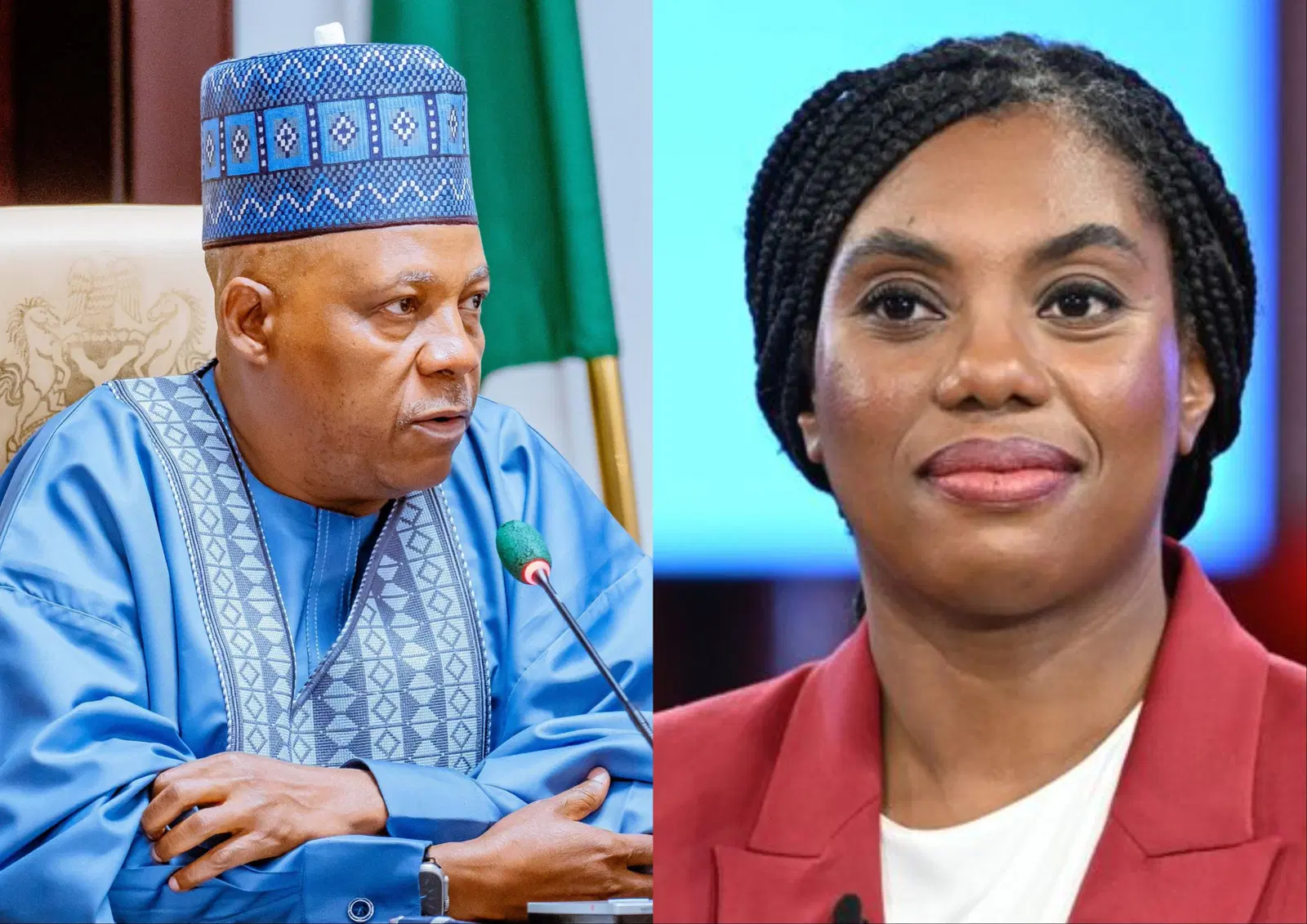
United Kingdom Conservative Party leader Kemi Badenoch has reaffirmed her critical remarks about Nigeria, responding to Vice President Kashim Shettima’s accusation that she disparaged her country of origin. Badenoch, who was born in the UK and spent much of her youth in Nigeria, has often referenced her challenging experiences in the country to underscore her political positions.
Badenoch has previously painted a stark picture of her upbringing in Nigeria, describing a nation plagued by systemic corruption, insecurity, and socio-economic decay. In earlier statements, she criticized the country’s leadership, saying:
“I grew up in Nigeria, and I saw firsthand what happens when politicians are in it for themselves, when they use public money as their private piggy banks, when they pollute the whole political atmosphere with their failure to serve others. I saw what socialism is for millions. I saw poverty and broken dreams. I came to Britain to make my way in a country where hard work and honest endeavour can take you anywhere.”
Her comments prompted a sharp rebuke from Nigeria’s Vice President Kashim Shettima, who accused her of unfairly portraying Nigeria in a negative light. Shettima contrasted her remarks with the stance of Rishi Sunak, the UK’s former Prime Minister of Indian heritage, who, according to Shettima, has never criticized his ancestral country. He suggested Badenoch should consider changing her first name if she no longer wished to associate with Nigeria.
In response, a spokesperson for Badenoch made it clear that she stands firmly by her statements.
“She is the leader of the opposition, and she is very proud of her leadership in this country. She tells the truth. She tells it like it is. She’s not interested in doing PR for Nigeria and stands by what she says.”
The controversy has sparked widespread debate, with some praising Badenoch for her candid reflections on systemic issues in Nigeria, while others argue that her comments unfairly tarnish the country’s image on the global stage.
Badenoch has consistently defended her approach, framing her criticisms as a necessary part of her political identity and a reflection of her lived experiences. However, the episode has also raised questions about the balance between personal narratives and national representation, especially for politicians with ties to multiple countries.
The diplomatic sparring between Badenoch and Shettima highlights broader tensions surrounding perceptions of governance and development in Nigeria, as well as the role of diaspora leaders in shaping global discourse about their countries of origin.