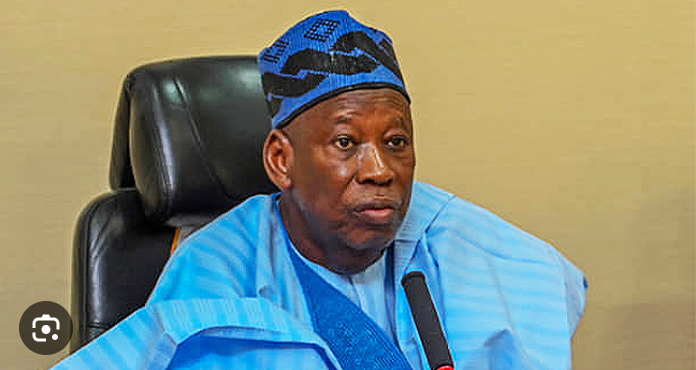
Abdullahi Ganduje, the National Chairman of the All Progressives Congress (APC), has resigned from his position amid growing internal tensions within the party, particularly regarding the possible return of his political rival and former Kano State governor, Rabiu Musa Kwankwaso.
According to credible sources at the APC national secretariat in Abuja, Ganduje tendered his resignation on Friday, June 21, 2025, after learning of ongoing negotiations between President Bola Ahmed Tinubu and Kwankwaso to bring the former governor into the ruling party.
Ganduje reportedly became unsettled by the development, prompting high-level interventions by party leaders, including National Secretary Ajibola Basiru and other principal officers, to dissuade him from stepping down. However, by 4:15 p.m., it was confirmed that Ganduje had submitted his resignation.
“We tried our best to talk him out of it, but he had made up his mind. His issue with Kwankwaso runs deep, and he doesn’t want to be in the same political camp again,” a party official who requested anonymity told Saturday PUNCH.
The rivalry between Ganduje and Kwankwaso dates back to their days as governor and deputy governor of Kano State under the Peoples Democratic Party. Their alliance broke apart after Ganduje succeeded Kwankwaso in 2015 under the APC, leading to a bitter power struggle for control of Kano’s political structure.
One flashpoint of their feud was Ganduje’s 2020 decision to depose Emir Muhammadu Sanusi II, seen as an ally of Kwankwaso. In a dramatic twist, Sanusi was reinstated in May 2024 by Governor Abba Yusuf of the NNPP, Kwankwaso’s political platform.
Although Ganduje publicly cited health reasons for his resignation, insiders believe the true motivation was political, driven by Tinubu’s apparent willingness to welcome Kwankwaso into the APC fold—a move many see as an attempt to strengthen the party’s base in the North ahead of future elections.
Adding to the intrigue, Buba Galadima, a long-time Kwankwaso associate, revealed that a high-level meeting allegedly took place where APC stakeholders and the presidency discussed “sacrificing” Ganduje and even Vice President Kashim Shettima to reposition the party. However, Galadima denied knowledge of any formal defection plans by Kwankwaso.
“I’m not aware of a defection plan. But yes, Ganduje and Kwankwaso are bitter rivals. I also know there was a meeting where it was suggested that Ganduje and Shettima be removed to bring new people into the government and party,” he said.
Reactions to Ganduje’s resignation were swift on social media. One of his aides, Salihu Yakasai, expressed dismay on X (formerly Twitter), posting: “TINUBU WHY, APC WHY,” accompanied by crying emojis. Former presidential media aide, Bashir Ahmad, confirmed the resignation on Facebook, calling it “effective immediately.”
In the wake of Ganduje’s exit, the APC is expected to name the party’s Deputy National Chairman (North), Ali Dalori, as the Acting National Chairman. This move aligns with the party’s constitution, which stipulates that the deputy from the same zone assumes leadership in an acting capacity if the chairman resigns.
As of press time, the APC has not issued an official statement. Party supporters gathered outside the national secretariat on Friday evening, awaiting confirmation from the National Working Committee (NWC). Multiple calls to the APC National Publicity Secretary, Felix Morka, went unanswered.
The unfolding situation signals a deeper power shift within the APC as it prepares for future political realignments—potentially with new players at the center of the party’s evolving leadership.