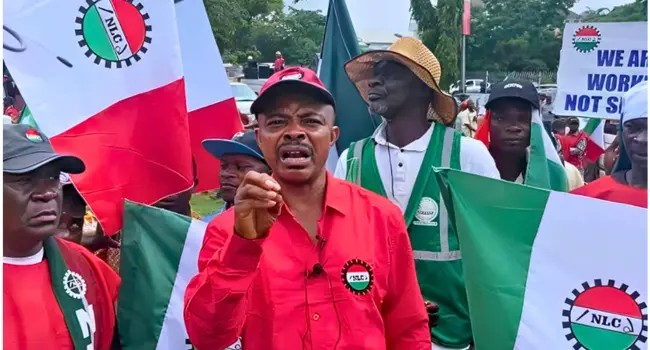
The Nigeria Labour Congress (NLC) and the Trade Union Congress (TUC) have announced an indefinite nationwide strike starting Monday, June 3rd, citing the federal government’s failure to finalize a new national minimum wage and reverse the recent increase in electricity tariffs. This move has been met with condemnation from the Organised Private Sector (OPS), which warns of potential economic fallout.
The decision follows a series of stalled negotiations. As previously reported, Labour negotiators walked out of meetings multiple times due to the government’s refusal to offer more than N60,000 as the new minimum wage. The impasse persisted as the government and OPS remained firm on this offer.
In a joint statement, NLC President Joe Ajaero and TUC President Festus Osifo criticized the absence of state governors and key federal representatives at the negotiation table. They expressed frustration over the lack of progress and the government’s apparent disregard for the urgency of the matter.
“Today’s meeting further demonstrated the unseriousness and apparent contempt with which the Nigerian state holds the demands of Nigerian workers and people,” said Osifo. “No Governor was present, and the Ministers were absent except for the Minister of State for Labour and Employment, who doubles as a conciliator.”
The Labour leaders emphasized that despite their ultimatum issued during the May Day celebrations, the government has shown little commitment to resolving the issues at hand. They demanded the reversal of the electricity tariff hike from N225/kWh back to N65/kWh and criticized the categorization of consumers into different bands.
“We carried out a nationwide one-day protest on May 13th, giving the government until the end of the month to act. Yet, there has been no positive response,” they stated. “Nigerian workers deserve fair and decent wages that reflect the current economic realities. The government’s inaction is disheartening.”
The NLC and TUC reiterated their call for all affiliates, civil society organizations, and the general populace to prepare for decisive action, highlighting the non-negotiable nature of their demands for worker welfare.
In response, the OPS, represented by Wale Smatt-Oyerinde, Director-General of the Nigeria Employers’ Consultative Association (NECA), expressed concern over the strike’s potential impact on businesses. The OPS includes key industry groups such as the Manufacturers’ Association of Nigeria (MAN) and the National Association of Chambers of Commerce, Industries, Mines and Agriculture (NACCIMA).
“The Organized Private Sector of Nigeria approached the Minimum Wage negotiation hoping that current economic realities would play a paramount role,” Smatt-Oyerinde stated. “However, the committee was set up to negotiate a new National Minimum Wage, not a living wage, and not to adjust salaries.”
The OPS warned that the strike could exacerbate ongoing job losses and business closures, emphasizing the need to protect jobs and ensure business sustainability amidst multiple economic challenges.
“Organized businesses are currently faced with multidimensional challenges, including multiple taxes, recent astronomical power costs, rising interest rates, and exchange rates. While Labour has the right to take necessary action, businesses will also act within the law to protect enterprise sustainability and jobs,” the OPS statement concluded.
As the strike looms, the Nigerian public faces a period of uncertainty, with significant implications for both workers and businesses across the country.