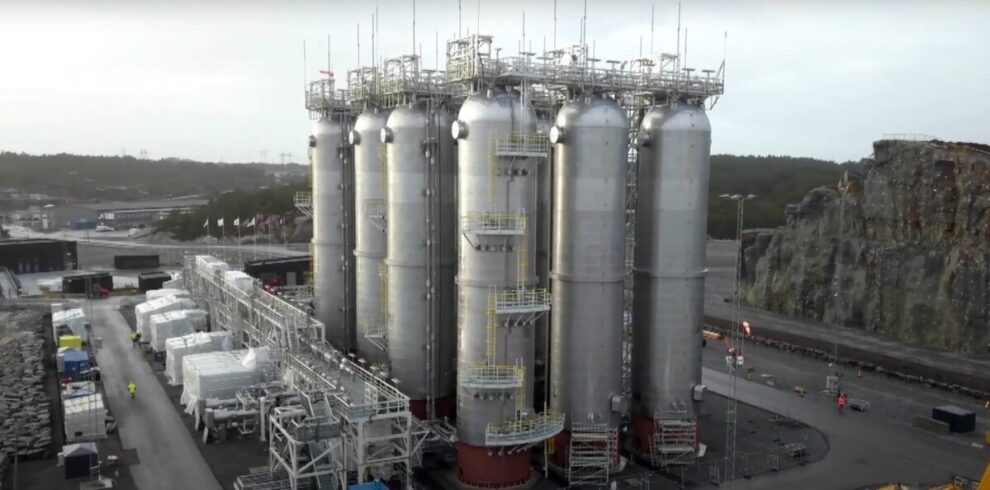
History was made off the coast of Norway as the world’s first commercial carbon storage service officially began operations with the injection of CO₂ into the North Sea seabed. The project, known as Northern Lights, is led by energy giants Equinor, Shell, and TotalEnergies, and marks a major step in global efforts to combat climate change.
The initiative involves capturing CO₂ emissions from smokestacks across Europe, liquefying the gas, transporting it by ship to Norway’s Øygarden terminal near Bergen, and injecting it through a 110-kilometre pipeline into a geological reservoir located 2.6 kilometres beneath the seabed. Once sealed underground, the CO₂ is intended to remain stored permanently, preventing its release into the atmosphere.
“We have now safely injected and stored the very first CO₂ in the reservoir. Our ships, facilities, and wells are fully operational,” said Tim Heijn, Managing Director of Northern Lights.
The first injection originated from Heidelberg Materials’ cement plant in Brevik, southeastern Norway—an industry that is notoriously hard to decarbonize. The consortium has also secured contracts with a Yara ammonia plant in the Netherlands, two of Ørsted’s biofuel plants in Denmark, and Stockholm Exergi’s thermal power plant in Sweden.
Carbon capture and storage (CCS) technology has been endorsed by both the UN Intergovernmental Panel on Climate Change (IPCC) and the International Energy Agency (IEA) as a key solution for reducing industrial emissions in sectors such as steel and cement.
However, the technology remains costly. Without government support, many companies find it cheaper to purchase carbon credits in Europe’s emissions trading market than to pay for CCS. Recognizing this, the Norwegian government has heavily financed Northern Lights to establish it as a global test case.
The facility currently has an annual CO₂ storage capacity of 1.5 million tonnes, with plans to scale up to five million tonnes by 2030. Advocates believe it could serve as a blueprint for international efforts to tackle climate change while creating a new commercial market for CO₂ disposal.