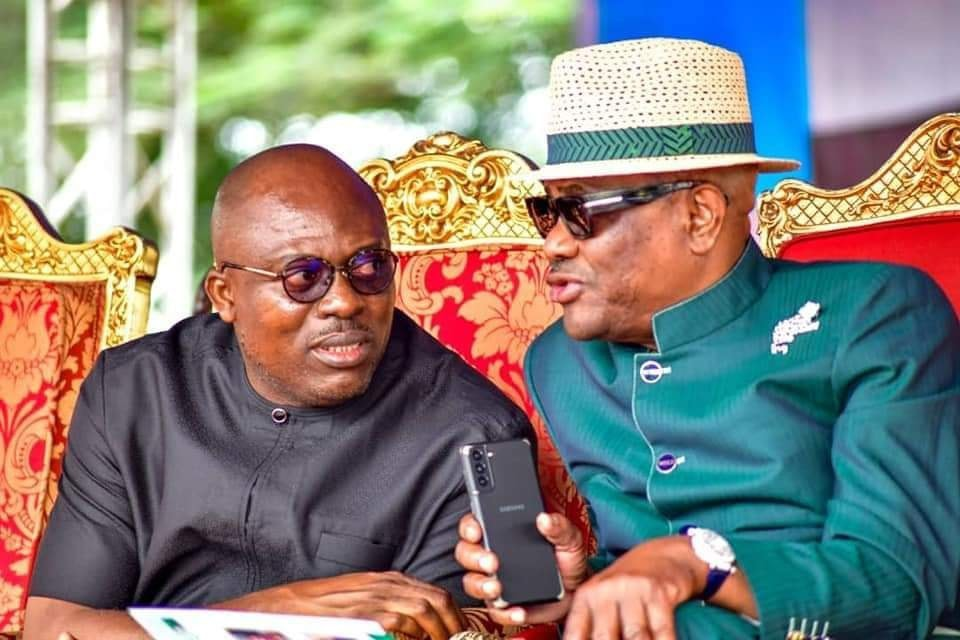
The intricate political landscape of Rivers State has once again become a battleground as former allies turned political adversaries, Governor Nyesom Wike and his erstwhile protege, Siminalayi Fubara, engage in a high-stakes power struggle.
The saga began against the backdrop of the 2023 general elections when the once-firm bond between Wike, then governor of Rivers State, and Fubara, the state Accountant-General, appeared unassailable, resembling that of a father and son. Wike, in his twilight as governor, strategically positioned Fubara as his successor, despite opposition from within the party ranks. This move sparked a rift within the Peoples Democratic Party (PDP) as stalwarts and aspirants contested the choice of Fubara, a relative political newcomer.
The aftermath of Fubara’s primary victory witnessed a fractured party structure, with dissenting voices, including former governor Celestine Omehia and other party stalwarts, expressing dissatisfaction with Wike’s selection. Nonetheless, Fubara’s landslide victory in the general election and subsequent inauguration marked the beginning of a new era in Rivers State politics.
Initially, the relationship between mentor and mentee appeared harmonious, but fissures soon emerged. Wike’s lingering influence in Fubara’s administration became apparent as key appointments and decisions bore the hallmark of his authority. However, tensions escalated when Fubara began asserting his independence, challenging Wike’s dominance and seeking alliances beyond the state’s borders.
The rift deepened with Fubara’s refusal to toe Wike’s line, prompting legislative maneuvers aimed at his removal. The state House of Assembly, under Wike’s sway, initiated impeachment proceedings against Fubara, triggering a political storm that culminated in the bombing of the assembly complex.
In a bold move, Fubara ordered the demolition of the damaged assembly complex, citing safety concerns. This drastic action further exacerbated tensions between the governor and his predecessor, leading to a protracted standoff.
The intervention of President Bola Tinubu offered a glimmer of hope for reconciliation, resulting in a fragile peace agreement. However, discontent simmered beneath the surface, with Fubara’s supporters decrying perceived bias in the accord.
Recent developments, including threats of impeachment and widespread protests, underscore the deep-seated divisions within the state. Fubara’s efforts to consolidate power face formidable opposition from entrenched interests loyal to Wike, who retains significant influence within the party hierarchy.
As the political drama unfolds, Rivers State finds itself at a crossroads, torn between competing factions vying for control. The outcome remains uncertain, but one thing is clear: the battle for supremacy shows no signs of abating, casting a shadow over the state’s political landscape.