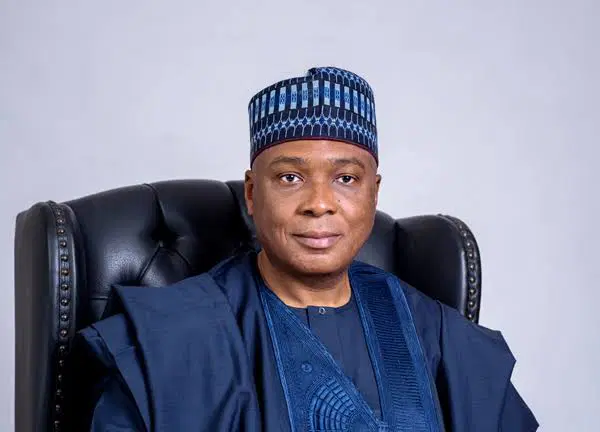
As the People’s Democratic Party (PDP) navigates one of its most challenging political seasons in years, former Senate President and Chairman of the PDP Reconciliation Committee, Dr. Bukola Saraki, has raised alarm over the possibility of more defections from the party in the coming months.
Speaking during an exclusive interview on Arise Television on Friday, Saraki painted a sobering picture of the PDP’s internal crisis, noting that what the public has seen so far may only be the beginning. According to him, more governors and lawmakers could abandon the party ahead of the 2027 general elections.
“We haven’t seen the worst of the defections for PDP. We would probably see maybe one or two governors who will defect, and we might see some senators who will defect,” Saraki said, emphasizing the importance of bracing for further political shakeups.
Despite the gloomy outlook, the former Kwara State governor maintained a sense of optimism, arguing that the early onset of the crisis is, paradoxically, a silver lining. “For some of us, this happening early in PDP is an advantage. We are lucky that this is not happening, let’s say, late 2026; we would not even have had time to recover and regroup,” he said.
With just under two years to the 2027 polls, Saraki said the PDP still has a viable opportunity to re-strategize and reposition itself. “It’s not a lost cause. A party with over 26 years of history will naturally experience low moments, but how we respond is what matters most,” he stated.
He also stressed the enduring strength of the party at the grassroots, dismissing assumptions that the internal discord at the national level has weakened the PDP across Nigeria. “When you go round the country, the state chapters, the local government chapters—the party is still very strong at the grassroots,” Saraki asserted. “In some areas, they are not even aware of what is happening in Abuja.”
Saraki revealed that the party is already laying a strategic foundation ahead of the 2027 election cycle. However, he warned that the upcoming national convention must mark a departure from past practices. “It must not be business as usual. We must bring in new, younger faces who represent the future of this party,” he said.
He concluded with a stark warning for the future of Nigeria’s democracy: “If PDP fails, Nigeria edges closer to a one-party state. And that would be a disaster for democracy.”
As the PDP continues to grapple with internal divisions and external pressures, all eyes are now on its leadership to see whether it can weather the storm or become another casualty of political realignment in Nigeria.