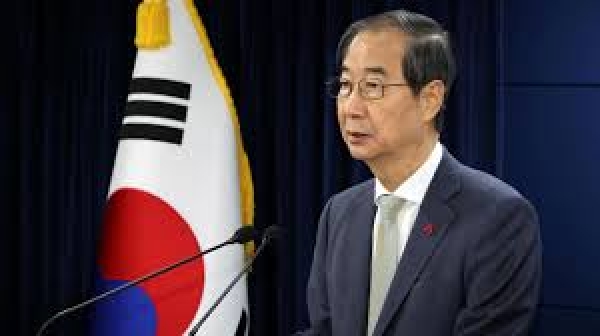
In an unprecedented political drama, South Korea’s parliament has impeached Acting President Han Duck-soo, just two weeks after voting to remove President Yoon Suk Yeol from office.
Han, who also served as prime minister, assumed the role of acting president after President Yoon’s impeachment. The president was ousted following accusations of attempting to impose martial law, plunging the country into political uncertainty.
The move against Han came on the heels of accusations by opposition lawmakers, who filed an impeachment motion on Thursday. They claimed Han deliberately obstructed the appointment of three judges nominated by parliament to oversee President Yoon’s impeachment proceedings, thereby stalling the process.
Tensions reached a boiling point on Friday as the National Assembly convened to vote on Han’s impeachment. Woo Won-shik, Speaker of the Assembly, declared that only 151 votes were required to pass the motion, rendering the support of lawmakers from the ruling People Power Party (PPP) unnecessary.
This announcement sparked outrage among PPP members, who accused the speaker of abusing his authority. The chamber descended into chaos as PPP lawmakers gathered in protest, chanting “invalid!” and “abuse of power!” before many of them walked out, boycotting the vote.
Despite the PPP’s absence, the impeachment motion passed overwhelmingly, with 192 lawmakers voting in favor of Han’s removal. Following the vote, Han will be officially suspended from his duties once notified by parliament.
The impeachment process now moves to South Korea’s Constitutional Court, which has up to 180 days to determine whether the parliamentary vote will be upheld.
Responding to the development, Han expressed respect for the assembly’s decision, stating, “I will wait for the constitutional court’s ruling.”
This marks the second impeachment of a national leader in less than a month, highlighting deep divisions within South Korea’s political landscape. Observers note that the impeachment of both the president and the acting president has created a power vacuum, further complicating governance in the country.
The opposition bloc, which pushed for Han’s impeachment, has argued that the moves were necessary to preserve the integrity of democratic institutions. Meanwhile, ruling party members view the actions as politically motivated, exacerbating tensions between the government and the legislature.
As South Korea awaits the Constitutional Court’s rulings on both Yoon’s and Han’s impeachments, the nation faces an uncertain political future with the potential for far-reaching implications on its domestic and international affairs.