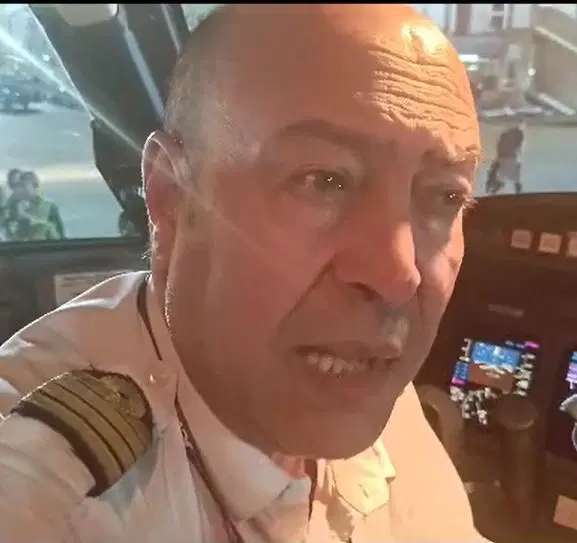
The Tunisian pilot who flew the Nigerian Super Eagles to Libya has provided new details surrounding the unexpected mid-flight diversion that left the team stranded for over 16 hours at a remote airport. The Nigerian national team, en route to Benghazi for their 2025 Africa Cup of Nations (AFCON) qualifier against Libya, was diverted to Al-Abraq, a small airport nearly 300 kilometers from their intended destination.
In an interview shared by sports journalist Pooja Media on X (formerly Twitter), the pilot clarified that the decision to divert the plane was made by Libyan authorities, not him. He explained that the flight plan initially approved by the Libyan Civil Aviation Authority was to land at Benghazi’s Benina International Airport. However, as they approached for descent, they were suddenly instructed to reroute.
“The flight plan was to land at Benghazi, Benina, and we had approval from the Libyan Civil Aviation Authority,” the pilot explained. “However, as we began our descent, we were instructed to divert to Al-Abraq, which wasn’t even listed as our alternate airport. This decision came from the highest Libyan authorities, not me.”
He emphasized the safety risks created by this diversion, noting that fuel was calculated based on landing in Benghazi. Diverting to a smaller airport, especially one not equipped with essential navigation systems like Instrument Landing Systems (ILS) and VHF Omnidirectional Range (VOR), posed additional challenges, particularly during night-time conditions.
“In aviation, we calculate fuel based on our destination. Diverting unexpectedly can compromise safety. I repeatedly questioned the directive and warned them about fuel limitations, but they insisted that we land at Al-Abraq, citing orders from the highest authority,” the pilot said.
The diversion led to widespread confusion and frustration within the Nigerian camp. Media outlets had earlier speculated that the diversion may have been the pilot’s decision. However, the pilot insisted that all communications with Libyan authorities were recorded and could be used as evidence, refuting any claims that he made the call to divert the plane.
Despite the difficult conditions, the pilot safely executed a visual landing at Al-Abraq, citing his prior experience in the region as a factor in navigating the risky situation. He described the airport as under-equipped, small, and primarily used for hajj operations, making it an unsuitable location for such an important international football delegation.
Following the ordeal, the Nigeria Football Federation (NFF) announced the Super Eagles’ withdrawal from the AFCON qualifier against Libya. The team was left stranded at the airport for over 16 hours without basic amenities or proper arrangements for onward travel.
“The players have resolved not to play the match, and NFF officials are now making arrangements to fly the team back home,” the NFF said in a statement.
Super Eagles captain William Troost-Ekong had earlier expressed his frustration on social media, describing the treatment of the Nigerian team as “disgraceful” and accusing the Libyan authorities of using “mind games” to unsettle the team ahead of the important fixture.
The NFF’s decision to pull out of the qualifier follows concerns over the safety, logistics, and welfare of the team, highlighting the difficulties and risks faced by visiting teams in politically unstable regions like Libya, which has continued to struggle with post-Gaddafi era turmoil.