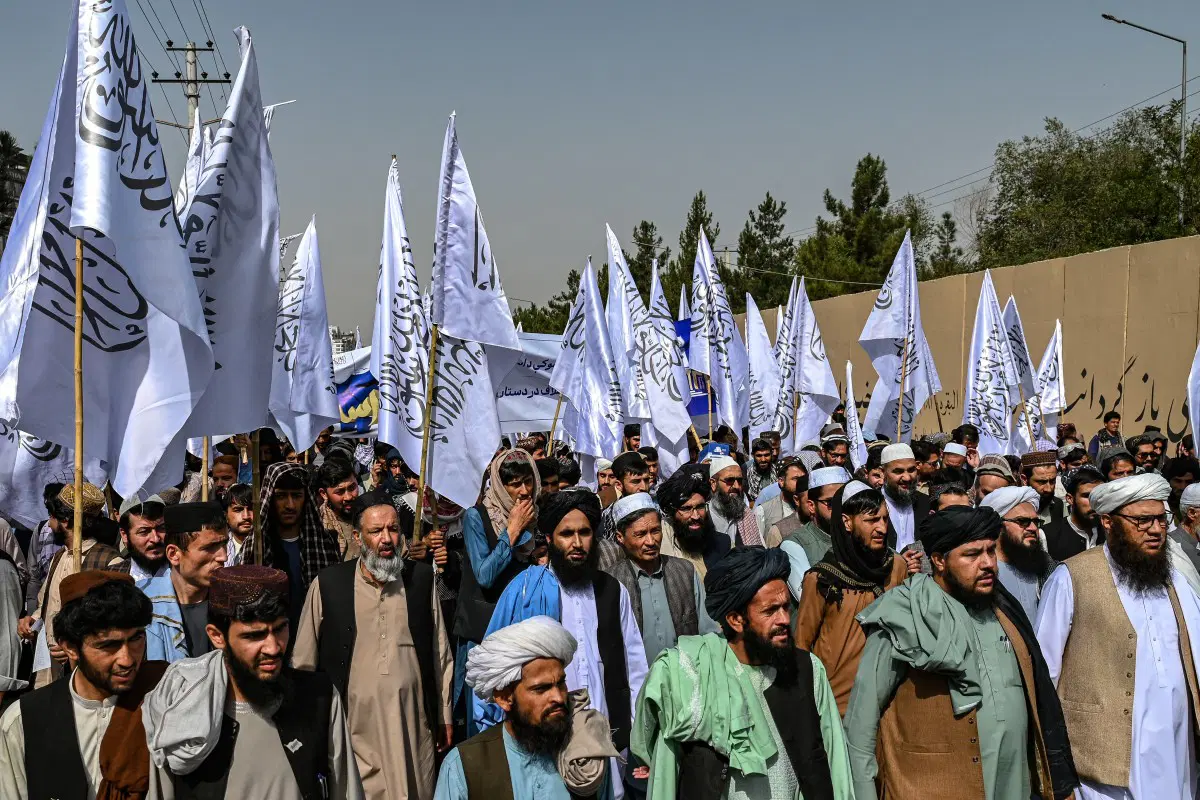
The Taliban marked the fourth anniversary of their return to power on Friday, celebrating with parades and symbolic displays in the Afghan capital and other cities, buoyed by Russia’s recent decision to formally recognise their government — the first such move by any country since their takeover in 2021.
The anniversary commemorates August 15, 2021, when the Taliban swept into Kabul, toppling the Western-backed government just weeks before the last U.S.-led troops withdrew. In central Kabul, white-and-black flags of the Taliban’s self-declared “Islamic Emirate of Afghanistan” adorned the streets, and helicopters were expected to release flowers over the city.
On Thursday night, Taliban members staged a flag-waving celebration near the former U.S. embassy — once the nerve centre of their fiercest adversary during the two-decade insurgency — with fireworks lighting the night sky. Unlike last year’s elaborate military parade at the former Bagram airbase, a key U.S. operations hub, no major military showcase was held this year, with no official reason given.
While the Taliban maintain firm control within Afghanistan and face little internal opposition, their government remains diplomatically isolated due to harsh policies rooted in a strict interpretation of Islamic law. These policies have drawn global condemnation, particularly over sweeping restrictions on women and girls, who are barred from most education, employment, public parks, gyms, and travelling without a male guardian.
The International Criminal Court (ICC) escalated international pressure in July, issuing arrest warrants for two senior Taliban leaders on charges of crimes against humanity tied to gender-based persecution.
However, the Taliban scored a diplomatic win earlier in July when Russia granted official recognition to their government. Kabul also enjoys close, though unofficial, relations with several countries, including China, the United Arab Emirates, and neighbouring Central Asian states. In recent months, Taliban officials have also met with envoys from Norway, Britain, and the United States.
Despite diplomatic outreach, the regime faces mounting economic difficulties, worsened by international aid cuts and the return of nearly four million Afghan refugees expelled from neighbouring countries.
International human rights experts appointed by the United Nations on Thursday warned against legitimising the Taliban government, urging the world to reject what they called its “violent and authoritarian rule.”
“Operating without legitimacy, the Taliban enforces an institutionalised system of gender oppression, crushes dissent, exacts reprisals, and muzzles independent media while showing outright contempt for human rights, equality and non-discrimination,” the experts said.
With Russia’s recognition, Taliban leaders hope other nations will follow suit, but for now, the group remains a pariah to much of the world — even as it consolidates power at home.