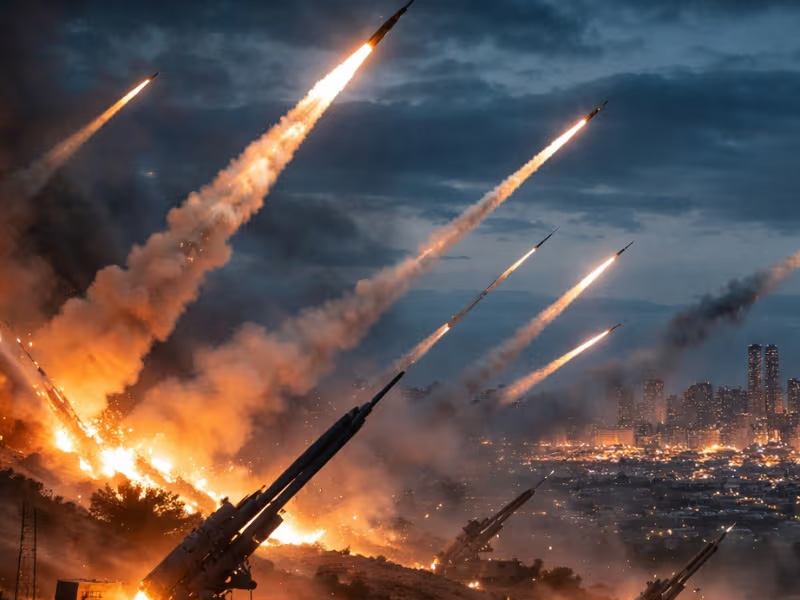
Iran launched fresh waves of missile attacks on Israel, sharply escalating tensions in the region while rejecting claims by former U.S. President Donald Trump that diplomatic negotiations were underway.
The Israeli military confirmed that air raid sirens sounded across several مناطق, including Tel Aviv, where explosions from intercepted missiles were heard. In northern Israel, debris from the interceptions reportedly damaged residential buildings, though no fatalities were recorded.
The renewed strikes came shortly after Trump stated on Truth Social that the United States and Iran had engaged in “very good and productive” discussions aimed at ending hostilities in the Middle East. He also announced a five-day delay on a proposed strike targeting Iran’s power infrastructure.
Trump’s remarks initially eased global market concerns, driving stock prices higher and pushing oil prices below $100 per barrel following earlier volatility tied to threats of military escalation.
However, Iranian authorities swiftly dismissed the claims. Parliament Speaker Mohammad Baqer Qalibaf said no negotiations had taken place, accusing the U.S. of spreading misinformation to influence global financial and energy markets.
Iran’s Islamic Revolutionary Guard Corps echoed the denial, describing Trump’s comments as “psychological operations” and signaling that military actions would continue, including potential strikes on U.S. targets.
The conflicting narratives have renewed uncertainty in global markets, particularly around the Strait of Hormuz, a critical passage for about 20 percent of the world’s oil and liquefied natural gas shipments.
Oil prices reacted quickly to the developments, with Brent crude rising to $104.21 per barrel and U.S. crude climbing to $91.93, reversing earlier losses.
Analysts warn that the situation remains highly unstable, with fears of broader regional conflict and possible disruptions to global energy supplies continuing to weigh on investor sentiment.