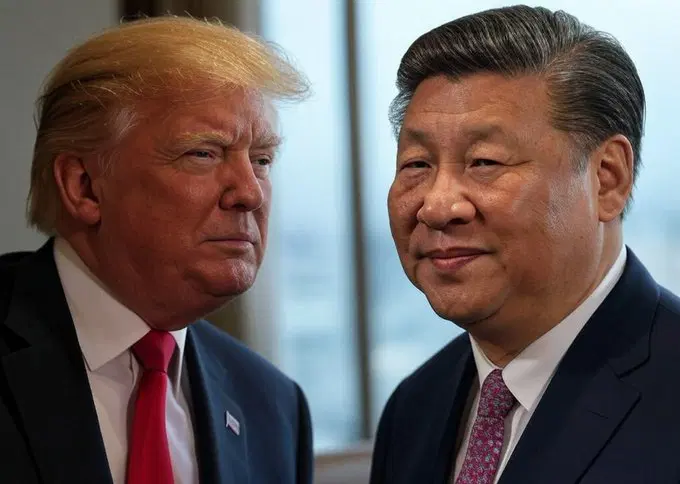
U.S. President Donald Trump on Friday reignited tensions with Beijing after announcing a sweeping 100 percent tariff on Chinese imports, coupled with threats to cancel an upcoming meeting with Chinese President Xi Jinping. The move marks a major escalation in the long-simmering trade conflict between the world’s two largest economies.
The new tariff package, which Trump said will take effect November 1, targets all Chinese goods, and is accompanied by expanded U.S. export controls on critical software. The measures, according to Trump, are in retaliation for what he described as China’s “extraordinarily aggressive” export curbs on rare earth minerals—key components in modern technologies such as smartphones, electric vehicles, and defense systems.
“It is impossible to believe that China would have taken such an action, but they have, and the rest is history,” Trump wrote on his Truth Social platform.
The president accused China of using its dominance in the rare earth market to “hold the world captive” and called Beijing’s stance “very hostile.”
Financial markets responded swiftly to the announcement, with Wall Street suffering major losses. The Nasdaq dropped 3.6 percent, while the S&P 500 fell 2.7 percent, as investors braced for renewed economic friction between Washington and Beijing.
The decision also casts uncertainty over the planned Asia-Pacific Economic Cooperation (APEC) summit in South Korea later this month, where Trump and Xi were expected to hold their first face-to-face meeting since Trump returned to office in January.
“I was to meet President Xi in two weeks, at APEC, but now there seems to be no reason to do so,” Trump wrote, suggesting the meeting could be scrapped.
Later, speaking in the Oval Office, Trump clarified that the meeting had not yet been formally canceled: “I haven’t canceled, but I don’t know that we’re going to have it. But I’ll be there regardless.”
The confrontation stems from China’s newly announced export restrictions on rare earth minerals, a move that sent shockwaves through global supply chains. Beijing reportedly sent formal notices to multiple countries outlining tighter controls on the strategic materials, which are crucial for industries ranging from clean energy to defense.
China currently produces nearly 70 percent of the world’s rare earth elements, giving it immense leverage in the global tech and manufacturing sectors.
Trump accused China of using the restrictions to gain political and economic advantage, describing Beijing’s move as a “multi-pronged attack” on Western economies.
The new tariffs will double existing duties on Chinese goods, which currently stand at 30 percent, imposed under Trump’s earlier trade policies. In response, China’s tariffs on U.S. goods remain at 10 percent, with Beijing signaling that it may retaliate further.
China on Friday also announced “special port fees” on ships built or operated by U.S. companies—an apparent response to U.S. restrictions placed on Chinese-linked vessels in April.
Trump, meanwhile, hinted at further economic countermeasures, saying “nothing is off the table.”
“Some very strange things are happening in China. They are becoming very hostile,” he said, suggesting Beijing was “lying in wait” despite months of diplomatic calm.
The renewed trade standoff comes as other nations express alarm over what Trump called “China’s great trade hostility.” Several U.S. allies reportedly reached out to Washington seeking clarity on the implications of the rare earth restrictions and tariffs.
The U.S. Federal Communications Commission (FCC) also announced Friday that it had removed millions of listings for banned Chinese electronic products from online marketplaces.
“The Communist Party of China is engaged in a multi-pronged effort to insert insecure devices into Americans’ homes and businesses,” said Brendan Carr, head of the FCC, on X.
The flare-up underscores the fragility of U.S.-China relations, with analysts warning that a full-blown trade war could disrupt global markets and stall recovery efforts. Despite Trump’s combative stance, some White House officials have reportedly urged behind-the-scenes diplomacy to prevent further escalation.