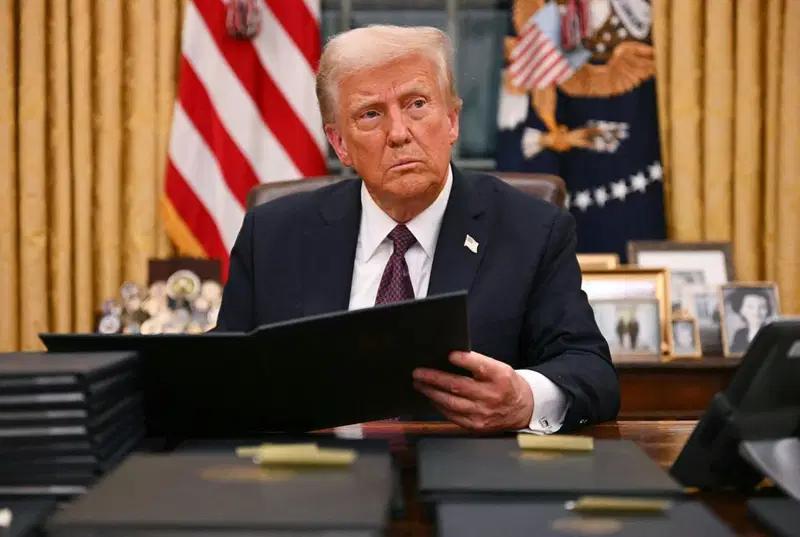
US President Donald Trump has defended his decision to end automatic birthright citizenship, arguing that the constitutional principle was designed to protect the children of enslaved people—not what he described as “wealthy foreigners” who travel to the United States to give birth.
Speaking in an interview with Politico, Trump reiterated his support for the executive order he signed upon returning to the White House in January 2025, which halted the automatic granting of citizenship to children born on US soil. The controversial order has ignited a nationwide legal battle.
Trump insisted that the intent of the 14th Amendment was historically misunderstood, claiming the legal framework “had everything to do with the babies of slaves” in the post–Civil War era.
“That case was not meant for some rich person coming from another country… and all of a sudden their whole family becomes United States citizens,” he said. Trump added that he believes judges “understand it, too,” stressing that the consequences would be “devastating” if the Supreme Court invalidates his order.
The 14th Amendment, ratified in 1868, declares that “all persons born or naturalised in the United States, and subject to the jurisdiction thereof, are citizens of the United States.” It was enacted to guarantee citizenship to formerly enslaved individuals and others born within the country.
Under Trump’s directive, babies born in the US more than 30 days after his January inauguration are no longer entitled to automatic citizenship. The policy immediately faced legal challenges, with lower federal courts issuing injunctions to halt its enforcement.
However, in a June decision, the Supreme Court ruled that federal judges lacked authority to impose sweeping nationwide blocks on executive orders, positioning the nation’s highest court to decide the constitutionality of Trump’s action.
Trump has framed the policy as an economic necessity, arguing that the US “cannot afford to house tens of millions of people.”
The Supreme Court is expected to hear arguments in the coming months. Its ruling could fundamentally reshape America’s immigration landscape and redefine longstanding interpretations of the 14th Amendment.