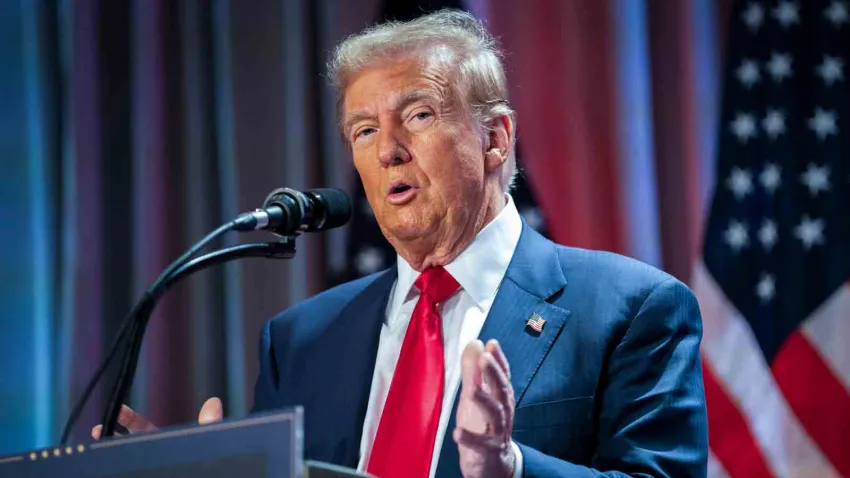
US President Donald Trump on Sunday expressed cautious optimism about reaching a diplomatic agreement with Iran, even as Tehran’s supreme leader warned that any American military action would ignite a regional conflict.
Speaking to reporters, Trump said he hoped negotiations could prevail despite rising tensions.
“Hopefully we’ll make a deal,” he said. “If we don’t make a deal, then we’ll find out whether or not he was right.”
His remarks followed a stark warning from Iran’s Supreme Leader, Ayatollah Ali Khamenei, who said a US attack would trigger a broader war across the Middle East. Addressing the nation, Khamenei urged Iranians not to be intimidated by Washington’s rhetoric, adding that recent unrest in the country amounted to a failed “coup.”
“The Americans should know that if they start a war, this time it will be a regional war,” Khamenei declared, accusing protesters of attacking police stations, government buildings, banks and mosques, and alleging foreign-backed interference.
The comments come amid a heightened US military presence in the Gulf, after Trump ordered an aircraft carrier group to the region following Iran’s forceful crackdown on nationwide demonstrations that began over economic grievances but evolved into widespread anti-government protests.
Iranian leaders have blamed the unrest on outside powers, particularly the United States and Israel.
Protester Released as Execution Claims Disputed
In a development that briefly eased tensions, Iranian authorities released 26-year-old protester Erfan Soltani on bail, according to his lawyer. His detention had drawn international attention after Washington warned he faced execution, prompting Trump to threaten retaliation if demonstrators were put to death.
Iran’s judiciary denied Soltani was ever sentenced to death, saying the charges against him — including propaganda against the Islamic system and actions against national security — did not carry the death penalty.
Tehran Signals Conditional Willingness for Talks
Iran’s Foreign Minister Abbas Araghchi acknowledged concerns over possible “miscalculations” between the two sides but suggested diplomacy remained possible. He said some regional countries were acting as intermediaries to restore trust, which Tehran says has been severely damaged.
“I believe President Trump is wise enough to make the correct decision,” Araghchi told CNN, adding that Iran could consider renewed talks if the US pursued what Trump has described as a fair and equitable deal focused on preventing nuclear weapons.
However, Tehran insists its missile and defence capabilities are not negotiable.
Conflicting Death Toll Figures
Iran’s presidency on Sunday released the names of 2,986 people killed during the protests, saying most were security personnel or civilians caught in what it described as “terrorist acts.” Authorities said the remaining unidentified victims would soon be named.
But the US-based Human Rights Activists News Agency reported a far higher figure, claiming it had verified 6,842 deaths, most of them protesters.
The crackdown prompted the European Union to designate Iran’s Islamic Revolutionary Guard Corps (IRGC) as a terrorist organisation. In retaliation, Iranian lawmakers voted to label European armies as terrorists, staging a symbolic show of support for the Guards in parliament while chanting anti-US and anti-Israel slogans.
Similar IRGC designations already exist in the United States, Canada and Australia.
While IRGC officials accused Iran’s enemies of trying to manufacture a war atmosphere, senior security figures said behind-the-scenes negotiations were still moving forward.
Trump confirmed that discussions were ongoing, though he stopped short of backing away from military threats, saying simply: “We’ll see what happens.”
The US president has repeatedly said he believes Iran would ultimately choose diplomacy over confrontation, even as both sides continue to trade warnings alongside cautious signals of dialogue.