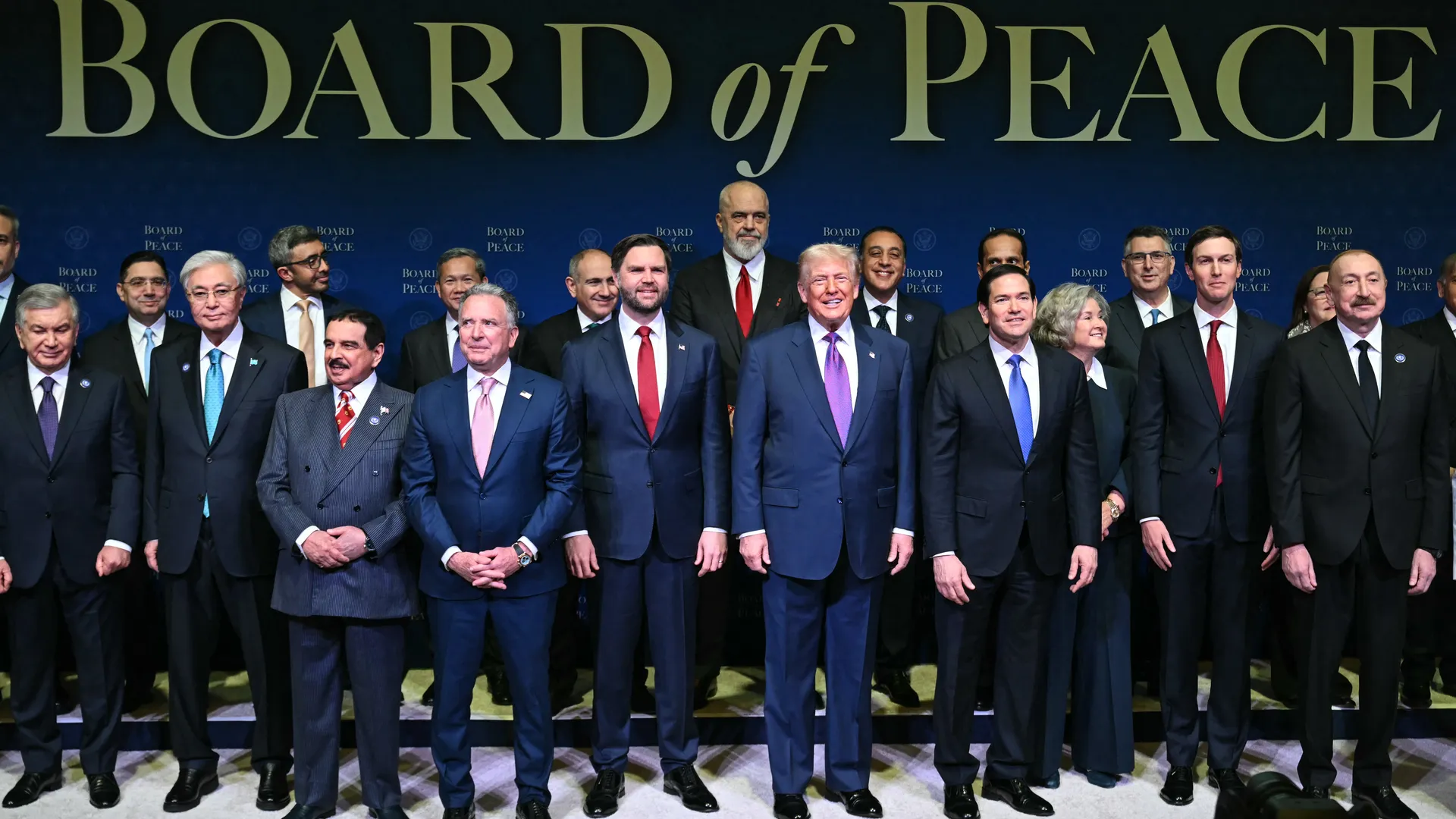
Former U.S. President Donald Trump pledged $10 billion at the inaugural meeting of the Trump-led Board of Peace on Thursday, as part of a broader $17 billion package aimed at humanitarian relief and reconstruction efforts in Gaza.
The initiative, which includes plans to deploy thousands of international troops and police officers to stabilize the enclave, marks what officials describe as the most ambitious U.S.-backed security and rebuilding effort in the Israeli-Palestinian conflict in more than a decade.
In addition to Trump’s $10 billion pledge — which would require approval from Congress — Gulf nations committed approximately $7 billion for Gaza’s recovery. The funds are expected to be transferred into a special account managed by the World Bank.
Speaking at the summit attended by more than 20 heads of state and foreign ministers, Trump also said the United Nations had committed to raising a further $2 billion for humanitarian aid, while Japan plans to convene an Asian donors’ conference. FIFA, he added, has pledged $75 million for football-related projects in Gaza. The UN estimates that roughly $70 billion will be needed to fully rebuild the territory.
An initial reconstruction blueprint was presented during the meeting, with efforts set to begin in Rafah, southern Gaza, an area still under Israeli military control.
Several Muslim-majority and Arab nations — including Indonesia, Morocco, Kosovo, Kazakhstan and Albania — agreed to contribute troops and police personnel to an International Stabilization Force (ISF) that will deploy to Gaza in the coming months.
U.S. Gen. Jasper Jeffers, named commander of the ISF, said the force will ultimately consist of 20,000 troops organized into five brigades, each assigned to different parts of Gaza. Deployment will begin in Rafah before expanding northward. Indonesia, which is contributing the largest contingent, will serve as deputy commander.
Ali Shaath, head of the Palestinian technocratic government, announced that a newly formed Palestinian police force will soon begin operations, targeting 5,000 trained officers within 60 days and an eventual total of 12,000 personnel. Recruitment has already attracted 2,000 applicants, according to Board of Peace high representative Nikolay Mladenov. Egypt and Jordan have offered to train the recruits.
Trump expressed confidence that Hamas would honor commitments to disarm, warning that failure to do so would carry consequences. Mladenov stated that the demilitarization process — covering missiles, rockets, tunnels and weapons production — would be overseen by the new Palestinian police force to ensure all weapons fall under a single civilian authority. He added that a framework for disarmament has been agreed upon by the U.S. and mediators including Turkey, Qatar and Egypt.
However, uncertainties remain. Hamas issued a statement after the meeting accusing Israel of violating the fragile ceasefire and urging board members to hold Israel accountable. While Israel participated in the summit, divisions persist within its right-wing government, with some members advocating a resumption of military operations.
With the ceasefire still delicate, the success of the sweeping reconstruction and security plan will depend heavily on Hamas’ willingness to disarm and Israel’s cooperation in supporting the proposed governance and stabilization framework.