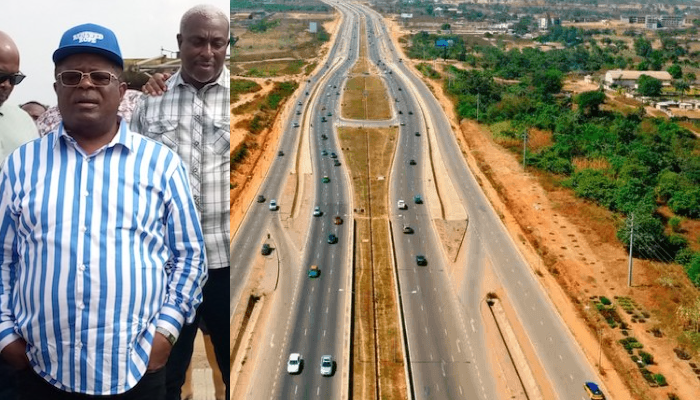
The Federal Government has announced a rerouting of the Lagos-Calabar Coastal Highway to prevent potential damage to subsea cables belonging to telecommunications companies. In addition, the project has been downsized from ten lanes to six to cut costs on the legacy project.
During a meeting with contractors on Tuesday in Abuja, Minister of Works David Umahi revealed these changes. He also stated that the government has disbursed N10 billion in compensation to property owners affected by the necessary demolitions for the construction of the 700km highway.
“The first 47 kilometers of the project will be open to the public by May next year,” Umahi announced. The construction of the Lagos-Calabar highway, which spans nine states with two spurs leading to the northern states, began earlier this year, utilizing concrete pavement.
The government formed a committee to review, assess, and compensate landowners affected by the expressway construction. On May 1st, payments totaling N2.75 billion began to be distributed to affected property owners.
The highway’s first section is set to start at Eko Atlantic and end at the Lekki deep sea port. Umahi emphasized the administration’s commitment to the project despite rumors of its cessation. “For the three legacy projects, including the Lagos-Calabar coastal highway, we have cut down the project size to six lanes in sections two, three, and four to show that we mean business,” he stated.
He explained the rerouting was necessary due to complaints from MTN regarding its subsea cable and issues raised by the Okuaja community. “We had to establish a new path, not aligned with the previous gazetted path, but far away and then returned to a new alignment at kilometer 25. The work is ongoing and progressing smoothly,” Umahi assured, praising the contractor’s efforts.
Umahi highlighted the project’s long-term benefits, describing it as an investment with potential returns. “By May 29, 2025, we aim to complete section one of the highway. We plan to acquire land for tourism, factories, and industries, which will help recover the investment costs within 10 years.”
He mentioned that the designs for sections three and four are nearly complete, with stakeholder engagements planned in Cross River or Akwa Ibom to facilitate procurement.
However, the minister also expressed concern over funding issues. “We inherited over 2,600 projects valued at N15 trillion,” he noted, explaining delays in payments to contractors. The government also initiated 330 emergency projects worth N260 billion, with over 80% completed.
Umahi emphasized the ministry’s stance against allowing contractors to inflate project costs through excessive price variations.
In related news, Julius Berger is set to resume construction on the remaining section of the Abuja-Kano road after resolving some challenges. “I commend Julius Berger highly; we resolved many issues, and construction will resume this week,” Umahi said.
Addressing the recent flooding of the Kara bridge, he confirmed the issue has been fixed, ensuring no further flooding. “In the coming days, CCTV installation on the bridge will be completed to enhance security, with a response time of less than five minutes from security agencies to prevent incidents,” Umahi concluded.