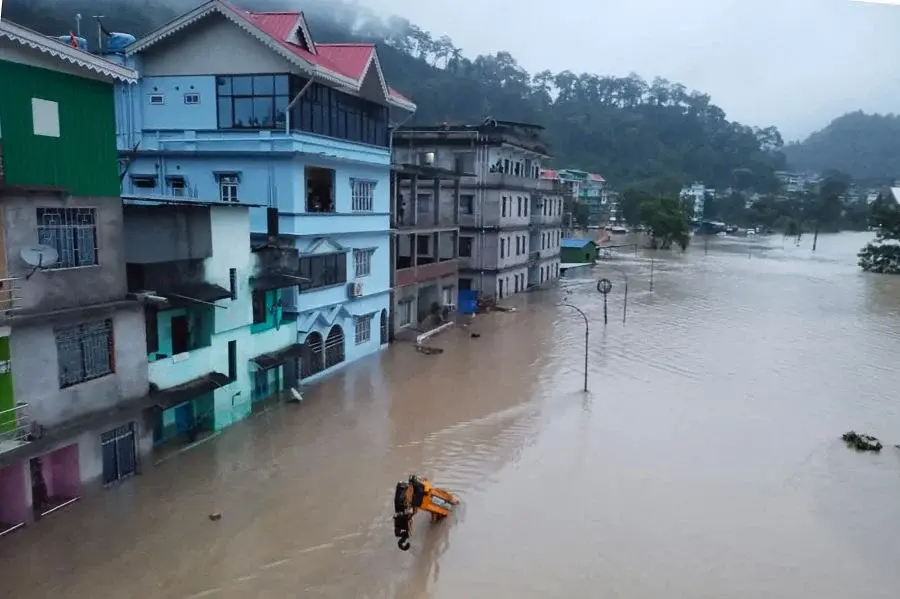
Sikkim, India – In a tragic turn of events, Indian rescue teams are tirelessly searching for 102 individuals who remain unaccounted for following a catastrophic flash flood triggered by a glacial lake burst at high altitude. The disaster has so far claimed the lives of at least 10 people, according to officials.
The incident has brought into sharp focus the growing peril posed by violent flooding events resulting from glacier lakes constrained by unstable rock formations. Climate scientists warn that as global temperatures rise and ice continues to melt, the wider Himalayan mountain range faces an escalating threat from such disasters.
Prabhakar Rai, director of the Sikkim state disaster management authority, reported, “At least 10 people were killed and 102 others reported missing” just a day after a massive wall of water surged through the mountainous valley in northeastern India.
The consequences of the deluge have been far-reaching. Roads have been severely damaged, and 14 bridges were washed away in the torrential floodwaters. Rescue teams are grappling with the challenge of aiding those affected, as communication networks are disrupted, and many roads remain impassable.
Himanshu Tiwari, a spokesman for the Indian Army, lamented the extent of the damage, stating, “Floodwaters have caused havoc in four districts of the state, sweeping away people, roads, bridges.”
Among the missing are 22 soldiers, with one previously unaccounted for soldier having been rescued. The army is working diligently to reestablish telephone connections and provide essential medical assistance to stranded tourists and locals.
The flash flood resulted from intense rainfall that breached the high-altitude Lhonak Lake, situated at the base of a glacier in the vicinity of Kangchenjunga, the world’s third-highest mountain. The accelerated melting of Himalayan glaciers due to climate change has left communities vulnerable to unpredictable and costly disasters, as highlighted by the International Centre for Integrated Mountain Development (ICIMOD) research group.
The unleashed water further swelled a river already engorged by monsoon rains, damaging a dam, sweeping away houses and bridges, and causing extensive destruction, as reported by the Sikkim state government. The impact of the disaster extended more than 120 kilometers (75 miles) downstream. In response, Prime Minister Narendra Modi has pledged “all possible support” for those affected.
Satellite images released by the Indian Space Research Organisation reveal that Lhonak Lake has dramatically shrunk, losing nearly two-thirds of its size—an area roughly equivalent to about 150 football pitches (105 hectares).
Miriam Jackson, a scientist specializing in glaciology who monitors Himalayan regions with the Nepal-based ICIMOD, commented on the dire situation, saying, “Intense rain has led to this catastrophic situation in Sikkim where the rain has triggered a glacial lake outburst flood and damaged a dam, and caused loss of life.” She went on to emphasize the increasing frequency of such extreme events as the planet continues to warm, leading humanity into uncharted territory.
While Earth’s average surface temperature has risen nearly 1.2 degrees Celsius since pre-industrial times, high-mountain regions around the world have warmed at twice that pace, according to climate scientists.
Sikkim, located near India’s borders with Nepal and China, maintains a substantial military presence. The shared frontier between India and China, stretching over 3,500 kilometers (2,200 miles), has long been a source of tension, with parts of Sikkim claimed by Beijing.