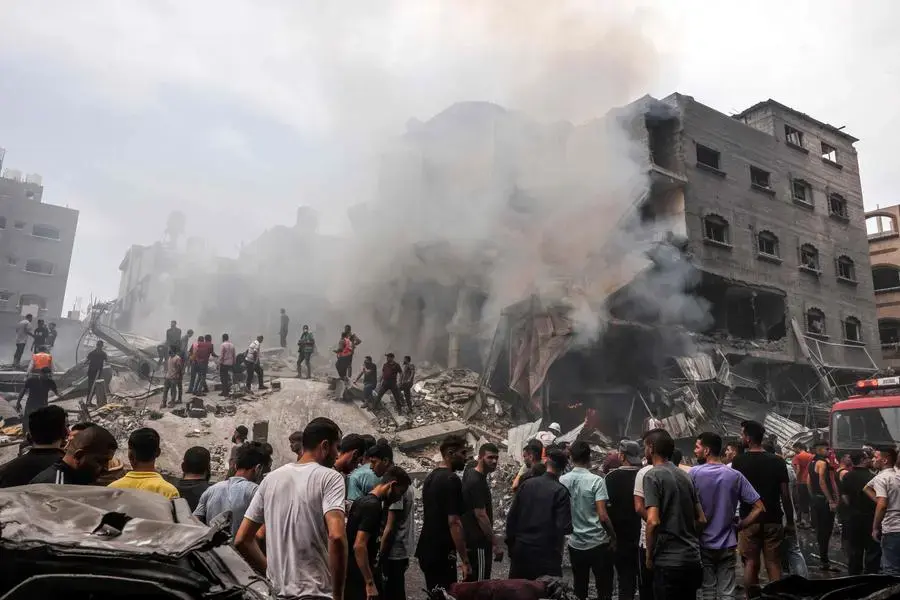
Egypt’s President Abdel Fattah al-Sisi has categorically rejected the forced displacement of Palestinians into the Sinai Peninsula, emphasizing that the only viable solution is the establishment of an independent state for the Palestinian people. President Sisi made this statement during a summit in Cairo, which marked a crucial moment in the ongoing conflict in the region.
As reported by the BBC, the summit commenced with the arrival of the first aid convoy into Gaza, following two weeks of intense warfare. Twenty trucks, laden with humanitarian assistance, crossed the Rafah border, marking a significant step in addressing the pressing humanitarian needs. However, various humanitarian organizations have cautioned that the aid provided is insufficient to address the magnitude of the crisis.
Before the outbreak of the conflict, the United Nations reported that approximately 500 trucks per day were entering Gaza to meet the needs of over 1.2 million people who relied on food aid within the territory. The UN is now tasked with the distribution of the incoming aid, with a considerable portion likely destined for UN schools, where thousands have sought shelter, as well as local hospitals.
In response to these developments, U.S. President Joe Biden expressed his “deep personal appreciation” to Egypt, Israel, and the United Nations for facilitating the delivery of aid. He affirmed the commitment to collaborating with all relevant parties to ensure the continued operation of the Rafah crossing, a critical lifeline for the welfare of the Gaza population.
Israel’s military, however, specified that the aid was intended solely for southern Gaza, reiterating calls for residents in the northern Gaza Strip to evacuate their homes and relocate south of Wadi Gaza in the central part of the territory. The Israeli government has previously vowed to eradicate the Hamas organization, which controls the Gaza Strip.
President Sisi, in his address at the “Summit for Peace” hosted in Cairo, reiterated Egypt’s stance against the displacement of Palestinians across the Rafah crossing into Egyptian territory. This position was supported by Saudi Foreign Minister Faisal bin Farhan Al-Saud. Additionally, Mahmoud Abbas, the head of the Palestinian Authority, which governs parts of the occupied West Bank but not the Gaza Strip, vehemently opposed the forced relocation of Palestinians, asserting their determination to remain on their land despite challenges.
The summit, however, concluded without a joint statement. Notably, there were no senior Israeli or U.S. officials present at the event, and significant differences emerged between Arab and European nations in attendance. Arab diplomats, speaking anonymously to AFP, revealed that European delegates called for a clear condemnation, holding Hamas responsible for the escalation, which was opposed by Arab leaders.
Ultimately, Egypt released a statement, endorsed by Arab delegations, criticizing world leaders for merely managing the conflict rather than achieving a lasting resolution. Egypt and other Arab states had previously expressed their rejection of an influx of Palestinian refugees, deeming it unacceptable as it would amount to the expulsion of Palestinians from their homeland.
King Abdullah of Jordan criticized what he perceived as “global silence about Israel’s attacks on Gaza” and the disproportionate loss of Palestinian lives. He emphasized the importance of valuing Palestinian lives equally to Israeli lives.
UK Foreign Secretary James Cleverly addressed the summit, stressing the need for the Israeli government to respect international law and protect civilian lives in Gaza. He called for discipline, professionalism, and restraint from the Israeli military and urged the international community to work collaboratively to prevent the Gaza situation from escalating into a regional conflict.
UN Secretary-General Antonio Guterres also addressed the summit, appealing for a “humanitarian ceasefire” and global action to end the ongoing crisis, describing it as a “godawful nightmare.” Guterres stressed the urgent need for a continuous and substantial delivery of aid to Gaza to address the dire humanitarian situation in the region.