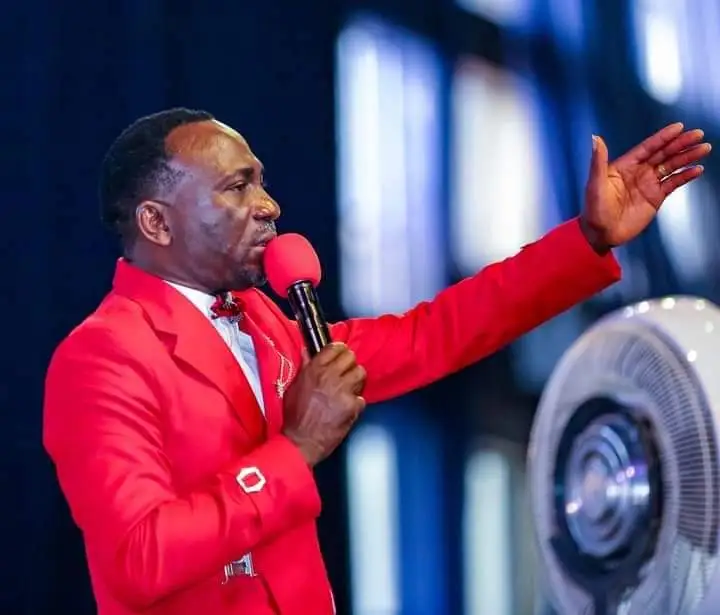
In a rare display of principle and transparency, the Senior Pastor of Dunamis International Gospel Centre, Dr. Paul Enenche, has publicly declined a ₦30 million donation from Kebbi State Governor Nasir Idris during a healing crusade held in the state.
The incident occurred at the Kebbi Healing and Deliverance Crusade, organized by Dunamis Church, where the state’s Commissioner for Social Welfare, Zayyanu Umar Aliero, appeared on stage to announce the donation on behalf of the governor. Aliero informed the large crowd that the donation was already available in cash and ready for immediate presentation.
“Our Governor, His Excellency Dr. Nasir Idris… has graciously approved the donation of ₦30 million to the organising committee of this crusade. And as is his custom, he ensures such donations are delivered in cash,” Aliero declared.
However, Pastor Enenche took the stage shortly after and made a bold decision—he respectfully rejected the donation, requesting instead that the money be directed toward helping the less privileged.
“If there is anything like orphanage, anything like that, at your discretion, please apply this amount of money to it. No, it will not be received by us,” Enenche said, drawing applause from parts of the crowd.
Speaking later to clarify the decision, Enenche emphasized the church’s philosophy of integrity and financial separation from government affairs.
“We are one of those who believe that government money should be used for government projects. Government resources should serve the people. Church money should be used for church work—no mix-up,” he said.
The pastor further cited the construction of Dunamis Church’s headquarters, the Glory Dome, as a model of financial independence.
“From the land acquisition to the structure itself, not one kobo of government money was used in building the Glory Dome. We rely on God and the generosity of the faithful,” Enenche added.
He proposed that if the governor wished to support Christian causes, the money should be given through recognized religious bodies, such as the Christian Pilgrims Welfare Board or the Christian Association of Nigeria (CAN), to preserve the Church’s independence and moral authority.
“That way, we maintain our dignity, we preserve our voice, and we can always speak truth to power without compromise,” he said.
Following the public rejection, Aliero acknowledged and praised Pastor Enenche’s firm stance, saying, “They don’t accept it because whatever he is doing, he is doing it for the sake of God. We appreciate and thank him for what he is doing in our state.”
The moment has sparked wide debate across social media, with many Nigerians hailing the pastor’s decision as a strong message about ethical leadership and the need for clearer boundaries between faith institutions and state resources.